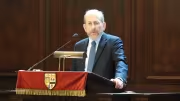
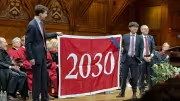
Tamara Elliott Rogers ’74, vice president for alumni affairs and development, announced today that she would step down at the end of 2018. The timing is logical: The Harvard Campaign, which she has directed, concludes June 30 (the end of the academic year), as does the presidency of Drew Faust, to whom Rogers reports; and by year-end, the final fundraising tally should be well in hand. That seems certain to be $9 billion or more—the largest higher-education capital drive in history—and so Rogers will need time to complete her numerous thank-you’s to the University’s tens of thousands of benefactors and volunteers. And by December, presumably, Faust’s successor will have settled into Mass. Hall, begun shaping her or his new administration, and set about identifying academic and other priorities that will figure in the next round of outreach for philanthropic support.
The magnitude of Rogers’s accomplishment extends beyond the impressive headline figure. Following the conclusion of the $2.7-billion University Campaign under President Neil L. Rudenstine, at the end of the last millennium, Harvard in effect skipped an entire fundraising cycle: the presidency of Lawrence H. Summers ended prematurely, and then the financial crisis and recession at the end of the decade made it impossible to launch a new effort. That 2008-2009 trauma also severely damaged Harvard’s balance sheet, making a huge capital campaign even more imperative to fund the major expansion of financial aid put in place before the crisis, address a backlog of pressing deferred maintenance, build new facilities, and more.
In her “bittersweet” message to the community conveying the news, President Faust noted, “Throughout the capital campaign, she has been a model steward of Harvard’s interests, always seeking to ensure that the whole is more than the sum of its remarkable parts.” On a more personal note, she wrote, “Almost from the day I was appointed dean of the Radcliffe Institute 17 years ago, I have benefited from Tamara’s dedication, professionalism, friendship, and wisdom.” Rogers’s leadership, she concluded, “will change Harvard forever.”
In an accompanying Harvard Gazette release, Rogers said:
It is almost impossible to describe how fulfilling and meaningful my work at Harvard has been. I have been extremely fortunate to be able to work with so many remarkable alumni and friends, students, faculty, and colleagues in service to the most important mission I can think of: education and research.
Corporation member Paul J. Finnegan, who is the University’s treasurer and chair of the Harvard Management Company board (and thus in position to be especially appreciative of the capital campaign’s central role in bolstering Harvard’s fisc), said:
Tamara is a very special person. For many of us, she has been an important mainstay of the University, which we value greatly. Her loyalty and longstanding commitment to Harvard are extraordinary. We are fortunate that she has built a strong team, because she will be missed.
Rogers was one of Faust’s first major appointments, in September 2007, signaling the new president’s intention to make a campaign one of her principal priorities. As noted then, the two had already worked together closely: as founding dean of the Radcliffe Institute for Advanced Study, Faust had appointed Rogers associate dean for advancement and planning in January 2001.
Rogers began working for Harvard in 1976, in the College’s student employment office. She later became a senior admissions officer, eventually directing international undergraduate admissions, before moving to the Faculty of Arts and Sciences development team in 1990. She played a lead role in raising funds for financial aid and served as director of major gifts during the Rudenstine-era campaign. After a brief sojourn in the private sector, she returned to the University development organization in 1998, and then moved to Radcliffe in 2001. Now, in completing a Crimson career that has extended through more than four decades, she is going out on the highest note imaginable. Come 2019, she plans to mix personal pursuits with consulting in the philanthropic sector.
As the report of her appointment in 2007 noted:
In concluding her review of giving in the 2005-2006 Radcliffe Institute annual report, Rogers wrote: “Year of Wonders, the title of a 2001 novel by [Radcliffe fellow and Pulitzer Prize winner] Geraldine Brooks, reminds me of the way we experience each year at the Radcliffe Institute, as our fellows analyze and reflect, discover and create. We are profoundly grateful to the many friends who make these wonders possible.”
Now she will engage with the University’s larger universe of friends in pursuit of even more ambitious wonders.
Indeed.