On Monday afternoon, Jewish students, Harvard administrators, and community members gathered in front of Widener Library to open “Hate Ends Now,” a nationally touring exhibit that displays a replica of the cattle cars used to transport Jews and others to concentration and death camps during the Holocaust.
“Cattle Car: Stepping In and Out of Darkness” invites participants into the train for a 20-minute multimedia presentation featuring Holocaust footage and testimony from survivors. Cattle cars like these were designed to carry “up to eight horses,” said Todd Cohn, director of Southern NCSY (a chapter of the Orthodox Union’s youth group that organized the national program alongside ShadowLight, a Holocaust education nonprofit). But during the Holocaust, Nazis packed each car full with “100 civilians: innocent men, women and children,” sending them to their deaths.
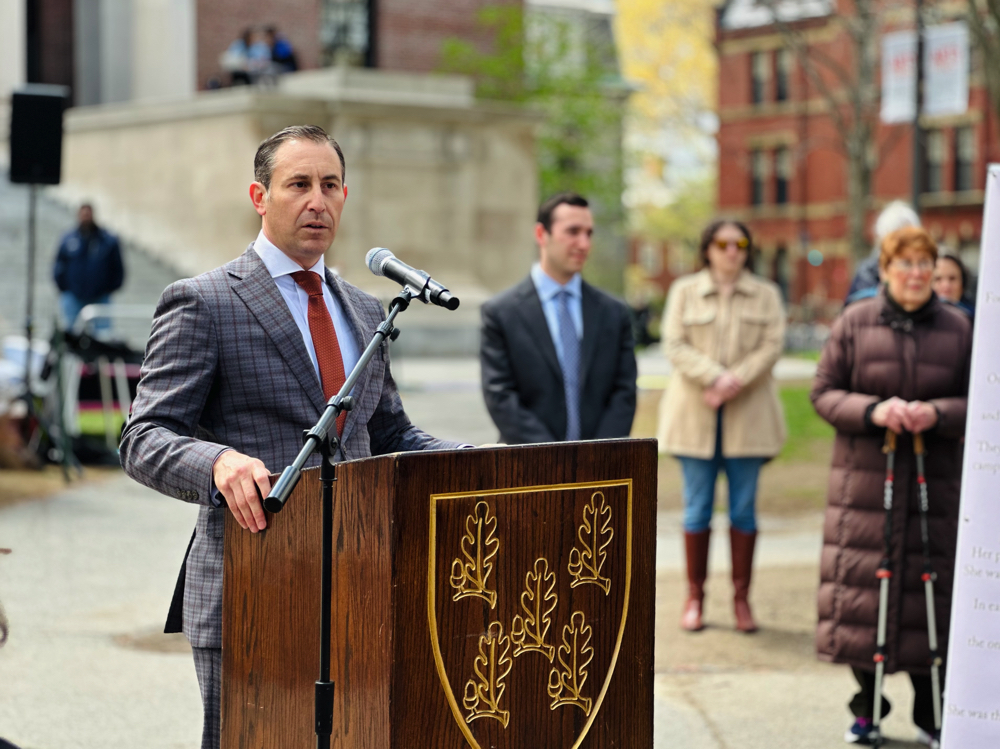
The red-brown train car and its boarded-up windows, harsh metal siding, and faded industrial German lettering looked eerily out of place in front of the Widener steps on a sunny afternoon.
Cohn and the event’s other speakers emphasized that in memory of the Holocaust, Americans should advocate against contemporary hatred. “‘Hate ends now’ is not a naïve statement,” said Jacob Miller ’25, student President of Harvard Hillel. “It is a very realistic one. It is a moral imperative that starts with remembering the past."
In the wake of rising antisemitism around the nation, the exhibit serves as a timely warning. Harvard College Dean Rakesh Khurana cited statistics from the Anti-Defamation League that “the number of antisemitic incidents was the highest it has been since they started collecting data in 1971.” Khurana suggested that “real progress for humanity should not simply be measured by how much we grow our economy or our wealth, but how we grow the circle of concern for one another.”
Provost Alan Garber reminded the audience that the Nazis did not just kill six million Jews during the Holocaust; they prevented countless future Jewish generations from coming into existence. Sharing a Talmudic expression, Garber told the crowd, “Whoever destroys a single life is considered by scripture to have destroyed the whole world. Whoever saves a single life is considered by scripture to have saved the whole world.”
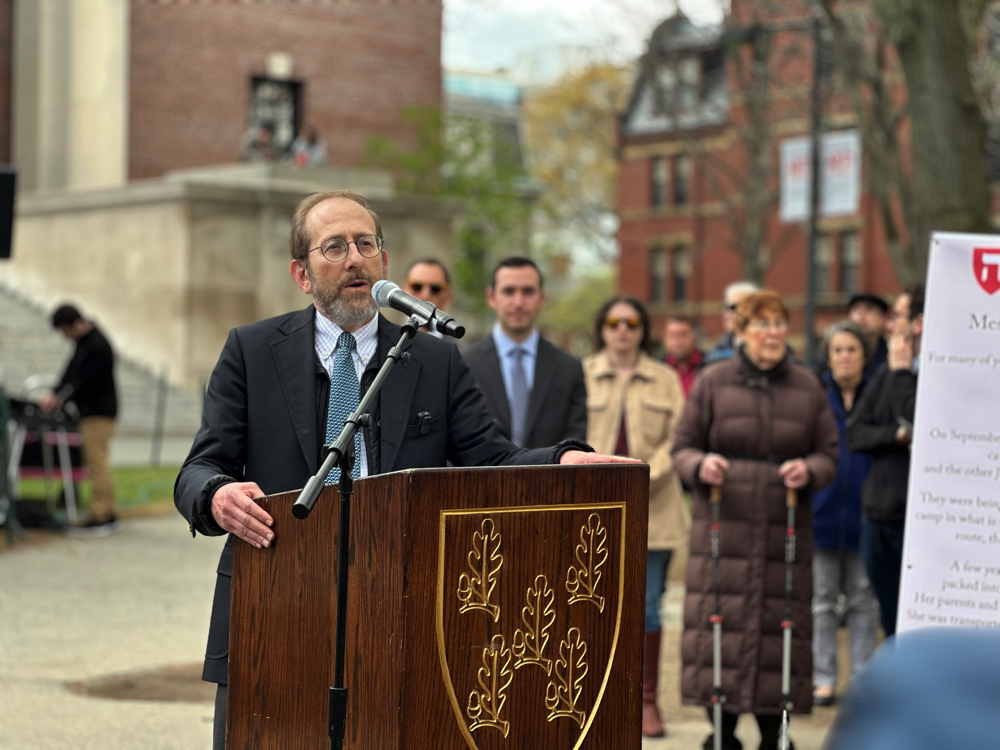
One of those saved is Harvard President Lawrence S. Bacow, whose mother survived the Holocaust. Bacow prepared remarks for the event, which were delivered by his Chief of Staff, Patti Bellinger.
For many of you, this cattle car is a reminder of the consequences of hatred and bigotry.
For me, it is far more.
On September 14, 1942, my mother, Ruth, was packed into a cattle car like this one with her family and the other Jews from her hometown of Londorf, Germany. They were being transported to Theresienstadt, a concentration camp in what is now the Czech Republic. Many of them died en route, the living and the dead jammed together.
A few years later, my mother and her family were packed into another cattle car bound for Auschwitz. Her parents and her sister died there. She was forced to work. She was transported again. She survived unspeakable conditions.
In early January of 1945, the Russians liberated my mother. She was the only survivor among her family, the only survivor among the people who had been transported from her hometown—one of 120.
She was 18 years old. She was the same age as our first-year students in Harvard College.
For many of you, this cattle car is a reminder of the consequences of hatred and bigotry.
For me, it is the family I never met.
View this post on Instagram
Speakers at the event noted how, in the words of Rabbi Jonah C. Steinberg, executive director of Harvard Hillel, “stories of the Holocaust are deeply entwined in the story of Harvard itself.” Peggy Shukur, interim regional director of the Anti-Defamation League, shared that her uncle, a Jewish refugee from Iraq, received a fellowship at Harvard right before the Holocaust that allowed him to stay in the United States and not return to his hostile home country. Over the last two decades, Harvard has welcomed about 100 intellectuals fleeing various kinds of persecution through its Scholars at Risk program.
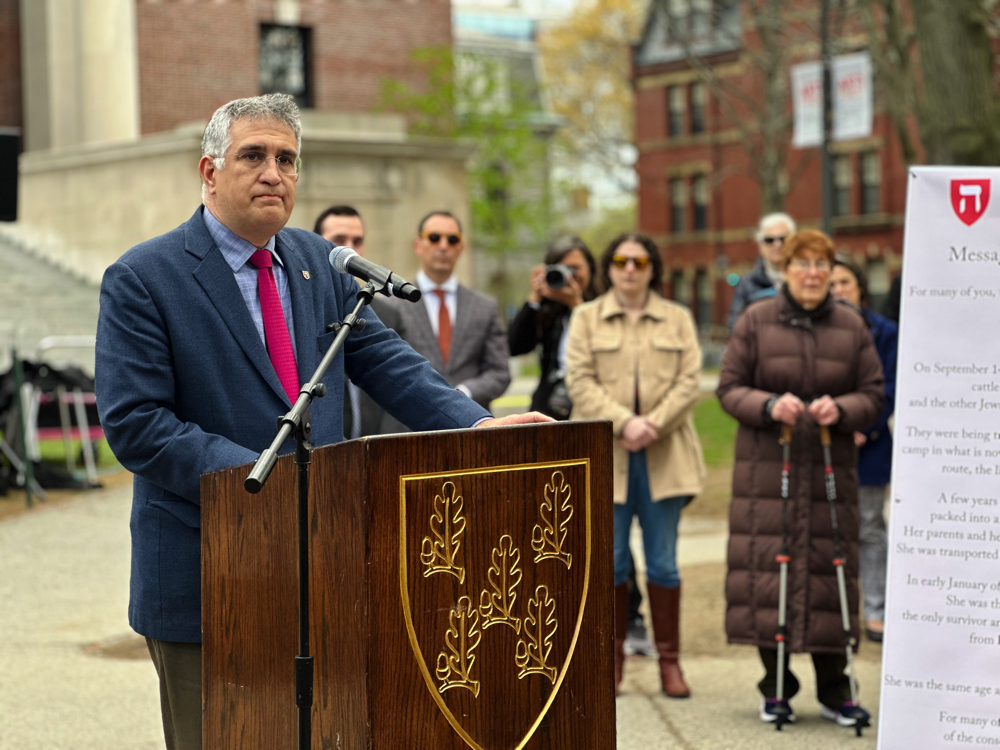
Though the Hate Ends Now program will only be on campus for two days, Provost Garber pointed out a permanent recognition of the Holocaust in the Yard. A linden tree between Boylston and Grays halls has a plaque commemorating a group of Harvard and Radcliffe students who helped 16 refugees flee Nazi persecution in Germany, Austria, and Czechoslovakia in 1938. “Like the cattle car, the linden tree is a symbol,” said Garber. “But not of death—of life. And it is a symbol that the work of preserving life and protecting others remains with us today at Harvard.”
The “Hate Ends Now” exhibit will be open in Harvard Yard today and tomorrow before continuing its tour through Massachusetts.