

This summer, the American Repertory Theater staged a new Gatsby musical with a full orchestra, an elaborate industrial set, and a pop-inspired original score. Its fall production, Romeo and Juliet, is much simpler, but equally inventive. Through its stage design and its cast’s acting, the A.R.T. enlivens Shakespeare’s classic while keeping largely true to the text.
Though the play begins with the line “Two households, both alike in dignity,” this staging focuses more on Romeo and Juliet than their families. Director Diane Paulus, who is also the theater’s Bloom artistic director, intentionally centered the couple, hoping to refocus the play on love. “It is often considered to be a play about hate,” she said in an A.R.T. press release. “I am interested in pivoting that framework: rather than defining our lives through hatred, can we choose to define our lives through love?”
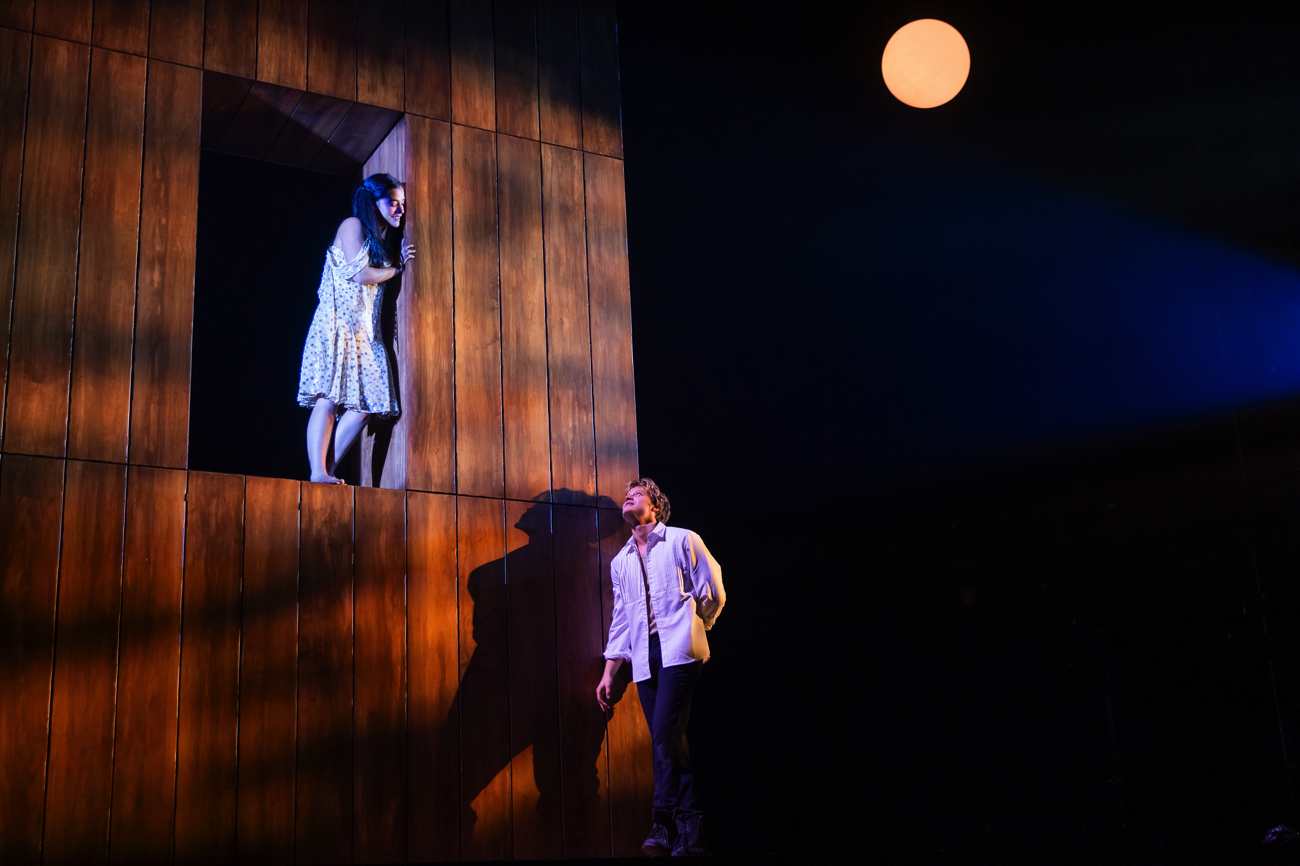
From the start, the production’s choices help energize the classic play. Actors push around a large wooden wall, a manifestation of the division between both the pair of lovers and the two clashing families. The constant movement of this wheeled wall—the only permanent stage decor other than the wooden floor—expands and shrinks the space, and adds physicality to the way the characters change the course of the story. Quickly, the actors lean into humor to grab the audience’s attention. An especially sassy “I do bite my thumb, sir” from Sampson (Adam Shaukat) makes the young characters feel like true teenagers.
The first love apparent to the audience is among Romeo (Rudy Pankow) and his friends, especially Mercutio (Clay Singer). The first half’s most memorable scenes involve the pair discussing the matters of the day, like whom to woo. Singer’s Mercutio—goofy, physically active, and boldly dressed—dominates the stage. He excels at physically unraveling Shakespeare’s coded prose, bringing the words to life.
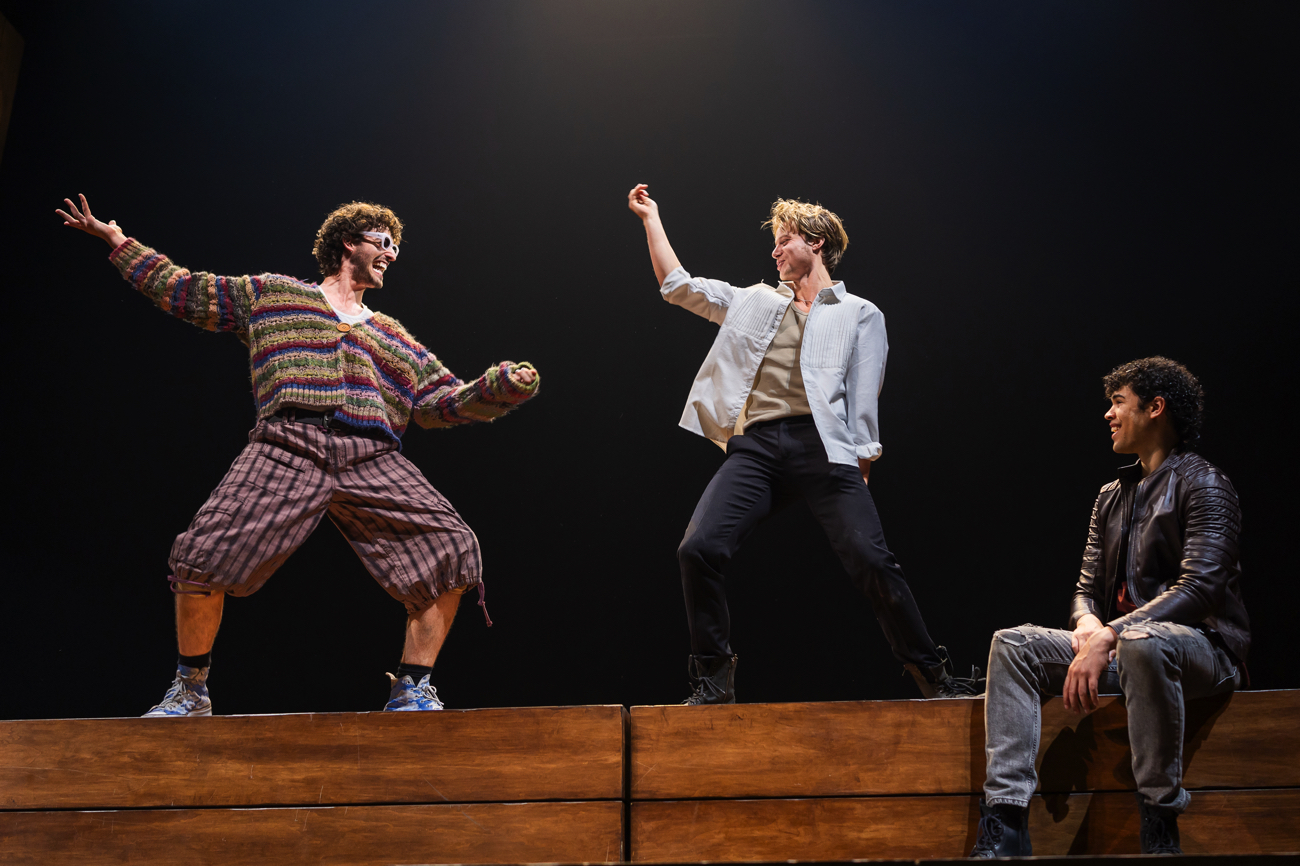
But at times, it feels as though Mercutio’s presence is too large. His silliness can overshadow the drama between the lovers and the tension between their families. Romeo sometimes tries to match Mercutio’s feral energy, which then makes Juliet (Emilia Suárez) seem small in comparison.
As the play progresses, though, Juliet comes into her own. Her monologues reveal the full range of emotions, and her movement is dynamic yet dainty. Even her most dramatic acts (like jumping up onto the famed wall) feel controlled.
The choreography, costuming, and lighting help Shakespeare’s words jump off the page. Fights pause for tableaus. Silly dance moves invigorate parties. Glowing spheres dramatize speeches. Hip outfits modernize the youthful characters.
Although such creative staging adds to the production, at its core, the A.R.T. production succeeds because of the actors. With their crisp speech, the cast explores a wide range of emotions, helping the audience feel the plight of the doomed lovers—the reason audiences have resonated with Romeo and Juliet for centuries.
Romeo and Juliet runs through October 6 at the American Repertory Theater.