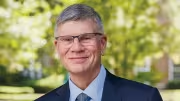
After graduation, David Battat ’91 thought his connection to Harvard would fade away. Yet when he became a volunteer alumni interviewer that same year, so began his “lifelong conversation” with the University. As Harvard Alumni Association (HAA) president this year, he is helping other alumni to join that conversation in “different ways and at different points in their lives.”
It happens through Harvard clubs, reunions, and campus events, or by joining Shared Interest Groups (SIGs). In 2020, Battat—who became a volunteer firefighter at age 16 and was a first responder at Ground Zero on September 11, 2001—co-founded a SIG, the Harvard Alumni Disaster Preparedness and Response Team.
Engagement also comes from service. Battat’s roles have included HAA elected director (2016-19) and chair of the HAA’s nominating committee (2022-23).
From Harvard, Battat went to Columbia Law School, clerked for then-U.S. District Court Judge Sonia Sotomayor, and worked as a criminal defense lawyer in New York City. Later, he became president and CEO of Atrion Corporation, a leading maker of medical devices that was acquired by the Nordson Corporation in 2024. These days, Battat splits his time between New York City and Tampa, Florida, while leading a start-up company that’s developing a device for delivering oncology drugs.
Of working with Harvard leaders amid the tumult caused by the Trump administration’s attacks on the University, Battat says that despite “one crisis after another,” the alumni community, increasingly diverse and global, “is still really strong.” There might be differing views on the lawsuits or grade inflation policies, he adds, but as a group, alumni are “highly engaged.” In June, the fifth annual Alumni Day drew more than 9,000 graduates—a record number.
This historic political period represents “an incredibly consequential moment for all of higher education,” Battat says. “And I think everybody’s seeing, from [those in the] Harvard alumni community to the public at large, just what an incredibly powerful voice the University has in shaping the direction of higher education for the next 10 to 20 years.”