The Year Harvard Scrapped Maid Service

Until the 1950s, professionals cleaned up after students in the dorms.

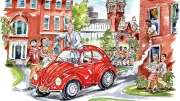
A chaotic scene in a messy room with people engaging in various activities, some cleaning.

Illustration by Mark Steele

For more than two centuries into the College’s existence, professional maids tidied up after the Harvard boys. Known on campus as “goodies,” “sweeps,” and “biddies,” the crew of female workers scrubbed floors, made beds, and dusted dorm rooms. They also fought for better working conditions. A campus union formed in 1936 won the maids a six-day workweek and 41 cents an hour. By 1952, they were working 20 hours a week at 96 cents an hour, “as well off as any other college maids in the country,” a Crimson story noted. But within a few years, as the University began phasing out deluxe dorm service, replacing it with a student porter system, a precursor to Dorm Crew.

The shift came at a time of post-World War II budget measures—and as maids were reportedly requesting another pay hike. On campus, according to another Crimson story, reactions to the announced change ranged. Some students were nonchalant. One applauded the addition of needed student jobs, while another thought that hiring some students to clean up after others could foster an undemocratic caste system. A proctor voiced concern that eliminating the maids was the College’s answer to their request for higher wage. At least one student archly lamented the loss: “One of the best things of living at Harvard is the elimination of that menial task of bed-making. The one last remnant of gracious living is in serious proximity to death.”

Read more articles by Nell Porter-Brown
Related topics

You might also like

A College student’s attempt to recapture the romanticism of the workplace.

The longtime administrator, who retired from the post in 2018, returns as the College reorganizes. 

A summer program helps students from under-resourced high schools close a hidden academic gap.

Most popular

The Harvard graduate’s roundtable talk show touches on hot button issues from religion to sex. 

Harvard’s Class of 2029 Reflects Shifts in Racial Makeup After Affirmative Action Ends

International students continue to enroll amid political uncertainty; mandatory SATs lead to a drop in applications.

In 1954, Gregory Corso moved into Eliot House. How he stayed there is a literary legend.

Explore More From Current Issue

Three young women posed side by side against red background.

The 2026-2027 Ledecky and Summer Undergraduate Fellows

Two laboratory researchers, one seated and one standing, in a scientific lab with equipment.

The stakes are high for this husband and wife: one of them will die if they don’t find a cure.

A smiling elderly man in glasses sits comfortably in a striped armchair.

Plus, veteran higher education leader Thomas Ehrlich reflects on university curricula for his 70th reunion