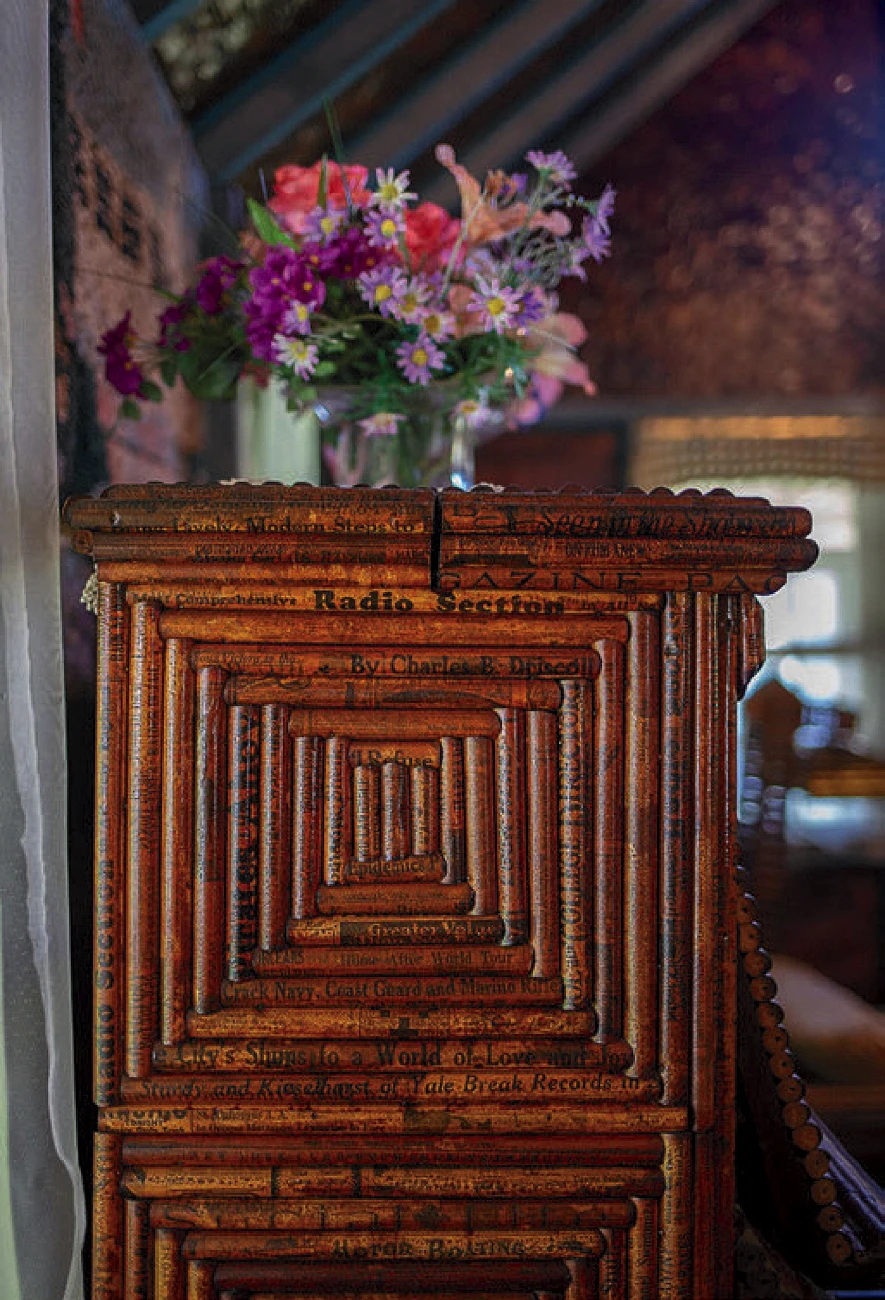
If you can read a room, why not an entire home? At the Paper House in Rockport, Massachusetts, visitors can peruse a writing desk to learn about Charles Lindbergh’s 1927 transatlantic flight, while the radio cabinet highlights Herbert Hoover’s 1928 presidential campaign. The piano offers “a mish-mash,” says Edna Beaudoin, grandniece of the cottage’s creator, like her favorite headline: “‘Dash for Safety Through Annihilating Seas.’ I mean, who uses the word ‘annihilating’ anymore, anyways?”
The idiosyncratic two-room summer home was built in the early 1920s by Elis and Esther Stenman, of Cambridge. Elis, an intellectually curious mechanical engineer, framed it out of wood before divining that reused sheets of newspaper could serve well as walls. He grafted thousands of sheets together and then slathered on marine varnish. Then he started in on the furniture. The couple had a kitchen (water came from a pipe outside) but used an outhouse (not made of paper). Beaudoin lives in the place next door, where the Stenmans moved in 1930 after opening their Paper House as an informal museum. Sundays were busiest and Beaudoin’s job was to collect the twenty-five-cent admission while her mother and grand-aunt answered questions inside. “I didn’t like it much,” she says. “Kids have other things to do.”
Yet since 1995, she has gladly been the caretaker, protecting the house from harsh weather and burrowing critters. She still opens it to the public from May through October—although admission has jumped to $3. Visitors pay via Venmo or stick cash in the mail-slot next door. “We use the honor system. People are basically honest. And if they’re not?” she says. “Well, that’s on them.”