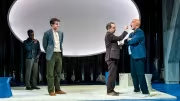
In 1976, Harvard planned to renovate a biological lab in Cambridge to enable researchers to experiment with recombinant DNA—then a novel technique for making viral and genetic modifications to living organisms. The changes were intended to bring the facility to a higher biosafety level.
But instead of a green light from the city, the University’s plan was met with protests, hundreds of hours of public debate, and a six-month moratorium on recombinant DNA research until the city devised its own regulations.
On a muggy June evening 50 years later, the MIT Museum and Central Square Theater invited residents back to City Hall to relive the debate in an immersive staging of the standoff. The show — titled “No Recombination Without Representation,” a reference to residents’ protest chants at the time—debuted on June 13, with performances at City Hall on June 14 and 21.
Michael John Gorman, director of the MIT Museum, said the reenactment was inspired by a conversation he had two years ago with Rice University historian of science Luis Campos, in which the two agreed that the debate was a “pivotal event for the relationship between science and democracy.”
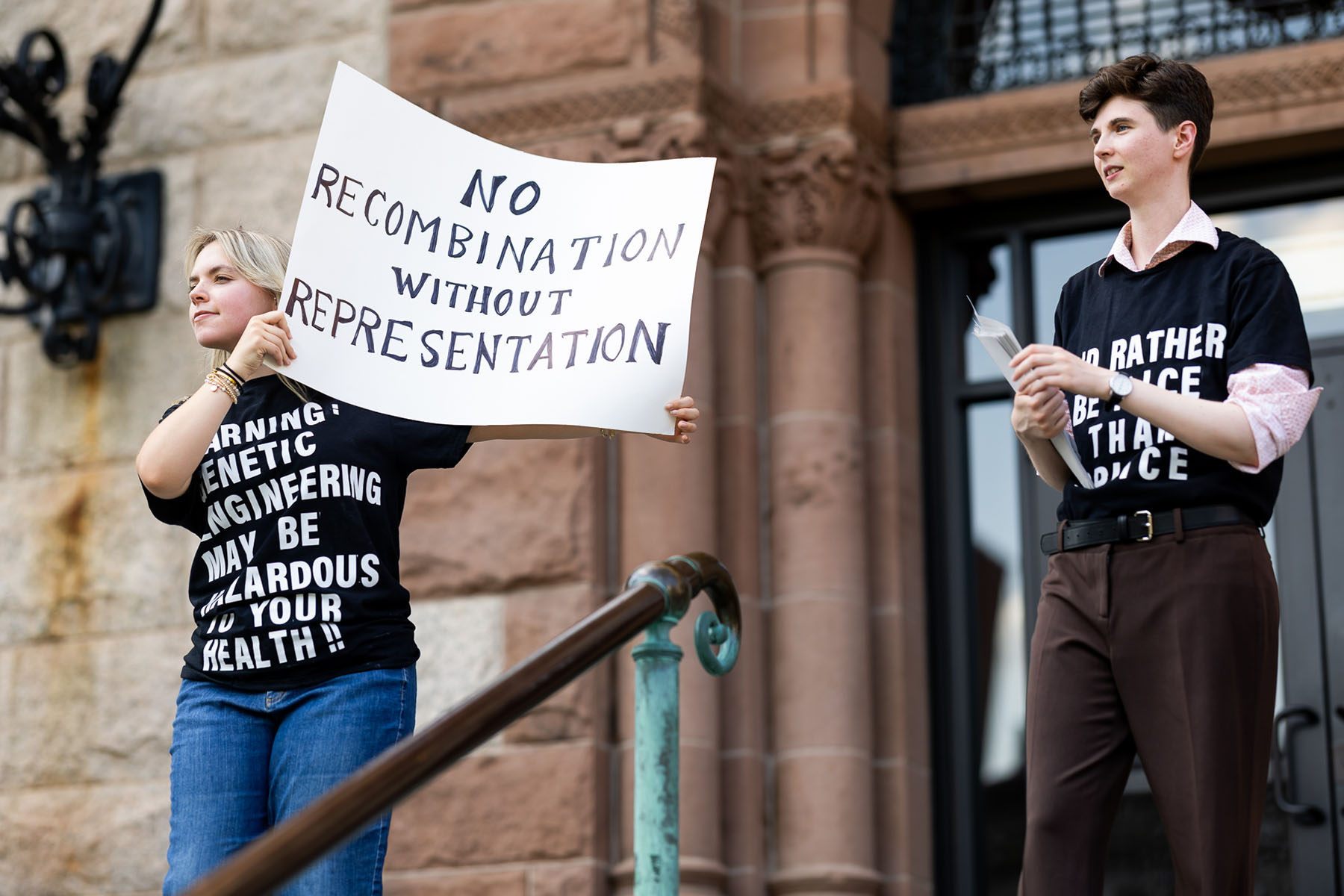
But rather than putting on a traditional stage play, Gorman pitched the idea of creating an immersive experience—because he felt the debate mirrored ongoing debates over technology today. Gorman and Central Square Theatre co-founder Debra Wise eyed Sullivan Chamber, the room in Cambridge City Hall where the City Council meets, as the venue. They recruited Patrick Gabridge, who specializes in theatrical productions in historic locations, as the playwright.
In 1976, little was known about DNA recombination—a technique that allows scientists to create genetic sequences that do not naturally exist by splicing together genes from more complex organisms and expressing them through a bacteria or virus. Research using recombinant DNA has since given rise to significant advances in modern medicine and biotechnology, including CRISPR-based genome editing and gene therapies that alter human DNA to cure a range of diseases.
But 50 years ago, when Harvard first brought plans for the new laboratory forward, administrators and researchers met with mixed reactions. While scientists argued the research was safe and necessary for medical and scientific advancement, residents worried that researchers would carry bacteria out of the lab with them, spreading infectious diseases across the city. Academics who worried about the implications of the research requested to have their offices moved. At the time, Cambridge Mayor Alfred Vellucci said he feared Harvard and MIT professors would create a “monster.”
On June 23, 1976, tensions came to a head at a public hearing before the Cambridge City Council. Hundreds of people packed into City Hall that night, and stayed until the meeting finally recessed at around 2 a.m.
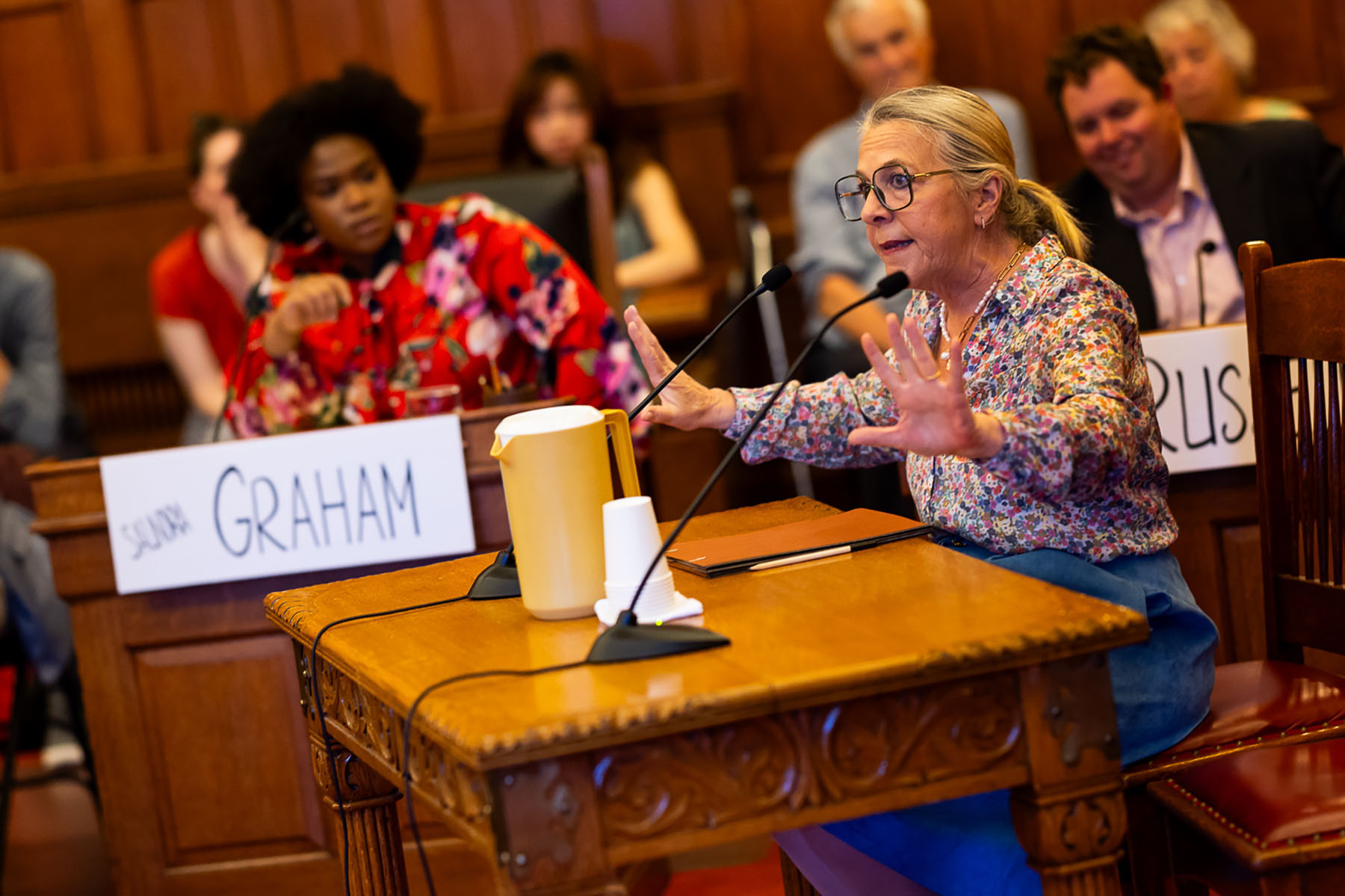
The dramatized retelling brought the audience into City Hall to participate in a similar scene, drawing the audience directly into the heart of the proceedings. Guests were invited to take seats in the public gallery, where residents would have waited their turn to offer public comment, while others stepped into the charged space at the center of the debate by sitting before the councilors themselves. Audience members could choose to align with either Harvard’s supporters or its opponents, experiencing the tension and anticipation that shaped the original meeting.
Mirroring the original debate, involvement from members of the public was critical.
“Whether this research takes place here or elsewhere, whether it produces good or evil, all of us stand to be affected by the outcome. As such, the debate must take place in public,” said Mayor Vellucci, played by actor Steven Barkhimer, as the dramatized meeting opened. Though not taken verbatim from the historical record, Gabridge’s dialogue reflected the sentiments expressed at the time.
The clash over recombinant DNA came on the heels of decades of tension between Harvard and Cambridge. For many residents, concerns about the experiments reflected a deeper frustration with Harvard’s relationship to the city—particularly a longstanding perception that the University operated behind closed doors while exerting enormous influence over local affairs.
“We’ve got nothing from you, nothing from the Senate, nothing from Congress, nothing from Harvard, nothing from anybody,” Vellucci said during the play.
In real life, after the back-and-forth depicted in the play, the City Council took action. In July 1977, the Cambridge government imposed a three-month moratorium on recombinant DNA research, cementing the city as the first municipality in the nation to intervene in scientific research. (The moratorium was later extended to six months.)
Alongside the moratorium, the Council also created the Cambridge Experimentation Review Board, which convened a first-of-its-kind group of laypeople to recommend policy concerning recombinant DNA research. In January 1977, after 75 hours of testimony and 25 hours of deliberations, the Board unanimously found that the research could safely be conducted under slightly stricter guidelines than those from the National Institutes of Health.
By February, a unanimous vote of the Council codified the recommendations into law, lifting the moratorium and allowing the research to proceed. In doing so, Cambridge became one of the first cities in the country to establish clear guidelines for recombinant DNA research, making way—ironically—for the biotechnology industry to boom in Kendall Square in the decades after.
At the immersive play, audience members were treated to a two-hour condensed recreation of the debate, Then, they were invited to a conversation with cast members and facilitators, using recombinant DNA as a starting point to talk about technology and risk in the present day.
“As we think about future directions of AI or synthetic biology, we cannot afford to leave the citizens behind and allow a handful of corporations to impose their vision,” Gorman said in an interview, adding that public discussions around the future of science, though messy, “can also lead to an extraordinary blossoming of innovation in the public interest.”