
 |
| Illustration by Bartek Malysa |
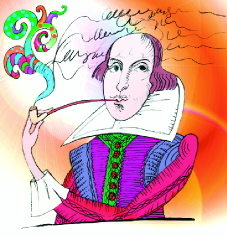
Perhaps the second-most-cultivated plant in Elizabethan England, after wheat, was hemp--Cannabis sativa, also known as marijuana. The sovereign herself encouraged its growth. Hemp fibers were fashioned into rope, paper, garments, and sails. "Queen Elizabeth's navy ran on that stuff," says Clay professor of scientific archaeology Nikolaas J. van der Merwe, who recently helped focus high technology on fragments unearthed from a literary dig to suggest that the Elizabethans may also have smoked marijuana for its mind-altering effects. One smoker may even have been William Shakespeare.
With colleagues Francis Thackeray and Tommie van der Merwe (not a relation), van der Merwe analyzed scrapings from the bowls and stems of 24 pipes dug from sites in and about Stratford-on-Avon. The Shakespeare Birthplace Trust provided fragments of kaolin (white clay) pipes, some unearthed from the garden at Shakespeare's residence and all dating from the 1600s. "There's an archaeological dating system for pipes, based on shape and the diameters of the bowl, stem, and stem bore," van der Merwe explains. "I scraped things out of them--mostly soil--but you could see little black flecks on the inside of the bowls."
When subjected to a chemical assay using gas chromatography and a mass spectrometer--as summarized in the South African Journal of Science--these flecks proved most interesting. Though cannabis itself degrades fairly quickly, cannabidiol and cannabinol are stable combustion products produced when it burns. (Van der Merwe has detected these substances in 600-year-old Ethiopian pipes.) Eight of the 24 pipe fragments showed evidence suggestive of such marijuana-related compounds.
Unexpectedly, cocaine also appeared on two specimens, including one from the Stratford home of John Harvard's mother. Cocaine was introduced from South America to Europe during the sixteenth century, the authors explain, "initially through Spanish conquistadors who in turn were raided by English explorers such as Sir Francis Drake, a contemporary of Shakespeare." Other pipes showed nicotine, implying the smoking of another New World plant, tobacco.
While no one knows whether Shakespeare himself smoked any of the pipes in question, the data of course provide fodder for speculation. The researchers muse on the phrase "noted weed" in Shakespeare's Sonnet 76, which also mentions "compounds strange." They ask if the "Tenth Muse" of Sonnet 38 might refer to chemical inspiration.
Scholars like Cogan University Professor Stephen Greenblatt, an authority on Shakespeare and general editor of the Norton Shakespeare, are amused but not persuaded. "I suppose it's remotely possible that Shakespeare and his family were getting a buzz from what they were smoking, but I very much doubt that it played any meaningful role in his life," Greenblatt says. "Shakespeare never mentions pipes, tobacco, or smoking anywhere in his poems or plays, in contrast with Edmund Spenser and other writers of the period. Alcohol is a much more likely stimulant for Shakespeare's imagination, and even that is probably unimportant. The seventeenth-century gossip John Aubrey described Shakespeare as not much of a partygoer--when he was invited to a debauch, he'd beg off, saying he was in pain. More likely, he was working on another play."
~Craig Lambert
Nikolaas van der Merwe e-mail address: nikolaas@beattie.uct.ac.za





