Nothing exceeds like success. Last summer, the Malkin Athletic Center (MAC) installed some new exercise equipment, completely refurbishing its weightlifting rooms. "We've gotten great feedback on it," says director of athletics Bob Scalise, M.B.A. '89. "And, of course, now the lines to use equipment are longer." With its convenient location between Kirkland and Lowell Houses, the MACthe former Indoor Athletic Building, renamed in 1985 when a gift from the Malkin family made possible a major renovationis a heavily trafficked facility. Perhaps a thousand faculty and staff members and students hoist dumbbells, sweat on treadmills, and swim laps there daily, straining it to capacity. Harvard hopes to rehab the structure again some time in the next few years.
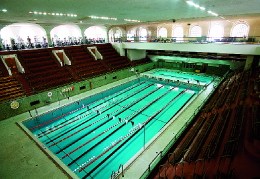 |
| The indoor swimming pool at Malkin. Future renovations will likely remove the rarely used spectator galleries at the sides. |
| Photograph by Jim Harrison |
The Faculty of Arts and Sciences (FAS) and the athletic department are jointly pursuing this project. They hired the architectural firm HNTB to do a space study for all of Harvard's athletic facilities and received the report this spring. "It's a needs analysis, a report on what we have and what we may need," says Scalise. "It did not provide plans or detailed options."
Currently, the MAC, which houses both recreational and intercollegiate programs, is home to three of Harvard's 41 varsity sports: wrestling, volleyball, and fencing. The ultimate goal, Scalise says, is "dedicating as much of the MAC as possible to recreational use, and relocating some of the intercollegiate programs to other facilities," probably in the Soldiers Field area. (Housing the migrant teams will create another design challenge, but the players should eventually gain benefits like improved locker space.) Within the MAC, a key goal is to generate "space that is flexible enough to be used for different activities," says Mike Lichten, assistant dean for physical resources in FAS.
The MAC's heavily used swimming pool is likely to remain, although the spectator galleries flanking it will probably disappear, because intercollegiate swim meets now take place at Blodgett Pool. "We want to take [underutilized] space and create more usable space," Scalise says. After soliciting proposals from architects during the summer, Harvard expects to choose a firm this fall to produce a detailed proposal with drawings.
One tricky aspect of renovating the MAC may be finding ways to keep its exercise facilities available while the work goes on. The basketball court, for example, might become temporarily a cardiovascular workout room. "That's one thing we will ask the architects: how do we phase in the plans to cause minimal disruption?" Scalise says. "The degree of disruption depends on what needs to be done. We won't know that for awhile."