Christopher M. Gordon, who joined the University in 2005 to direct accelerated development of the University’s planned campus growth in Allston, has decided to relinquish his position. President Drew Faust announced in an e-mail today that Gordon, who is formally chief operating officer of the Allston Development Group (ADG), would be “stepping down from his position this summer.” Gordon’s departure suggests that Harvard development throughout Allston—already in a suspended state—is receding further into the future. He has focused professionally on the management of large, long-term planned projects (a broader role than overseeing construction projects per se)—the subject of his graduate work and teaching at MIT. In light of current circumstances, Gordon said in a statement, "The work I came here to do will be happening at a slower pace and intensity as announced by President Faust last December and that reality led to today’s announcement."
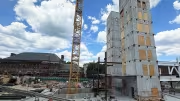
Construction of the first Allston project, a large scientific laboratory complex, has been halted, in line with the University’s announcement last winter. At the time, no date for resuming the work was projected, and Harvard raised the possibility of “co-development.” In light of the financial constraints imposed by the sharp decline in the value of the University’s endowment in late 2008 and early 2009, and the projected $1.4-billion cost of the science complex, it became clear that borrowing the sums required to proceed was not prudent. The scientists whose laboratories were to be sited in the new facility have been redirected to existing and renovated spaces in Cambridge and the Longwood Medical Area, making it possible that the partially built Allston complex will undergo changes of both design and ownership before it is finished. More broadly, the University has been seeking proposals for alternative uses, development options, and ownership structures for its Allston landholdings as a whole. But Harvard is not the only competitor in the market; Cambridge just approved a 1.7-million-square-foot biotechnology and research development in Kendall Square, which will be located closer to existing industry facilities and with faster access to the Massachusetts General Hospital complex than anything that might rise at the unfinished Allston science site.
The University announcement said that Gordon will continue to teach real-estate development at Harvard Business School (he also has been a lecturer at MIT, from which he earned his master’s in civil engineering), and advise on future capital projects. He and the ADG team have also been involved in planning and overseeing other major University capital programs: the reconstruction and expansion of the Fogg Art Museum, now under way; and initial planning for the renovation of undergraduate housing, a high priority for the Faculty of Arts and Sciences, but a potentially expensive ($1 billion or more) and long-term project.
Before coming to the University, Gordon was for a decade director of capital programs at the Massachusetts Port Authority, where he oversaw the $4.4-billion modernization of Logan Airport.