During the last 500 million years, the fossil record shows, the ecology of life on Earth has been disrupted and irrevocably altered half a dozen times. After the Great Ordovician Biodiversification had produced an order of magnitude increase in the number of species, five mass extinctions successively wiped out much of the life on the planet. The causes of these events have been the subject of renewed scrutiny ever since 1980, when Luis Alvarez (a Nobel Prize-winning physicist) and his son Walter (a geologist) advanced the theory that a meteor wiped out the dinosaurs and many other creatures 66 million years ago. Now, a study that quantifies the impact of such events on marine ecosystems—communities of ocean organisms living together in non-random associations—may help develop a more nuanced understanding of paleoecology that could ultimately shed light on the threat of species losses today.
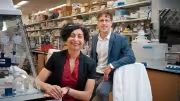
As a paleontologist and geobiologist, postdoctoral fellow Anthony “Drew” Muscente investigates the interactions between the biosphere and the physical planet. He uses the fossil record to study what is known as “co-occurrence data”: “what lived with what in the distant past.” By examining these data using network analysis, he and his colleagues identified ecologically significant associations among ancient marine animals, and then investigated how these individual species and communities changed over geologic time. The approach enabled them to rank the ecological impacts of mass extinctions.
Muscente says that once these “pulses of ecological reorganization throughout the fossil record” have been recognized, researchers can begin to measure them and try to quantify the consequences of such mass extinctions on entire ecosystems. This is relevant now because some scholars have argued that a sixth mass extinction is under way today. “That may or may not be true,” he adds, “but we need some historical context for understanding what species losses have done in the past to change the biosphere.”
“What’s interesting,” says Muscente’s postdoctoral adviser and collaborator on the paper, Andrew Knoll, Fisher professor of natural history and professor of earth and planetary sciences, is that the size of a mass extinction doesn’t reveal whether it will change the ecosystem. There’s “no necessary correlation between the taxonomic import of a mass extinction and the ecology,” Knoll explains. For example, even though the first great extinction, at the end of the Ordovician period, eliminated half the then-existing genera and some 80 percent of all species, an ocean reef in the wake of that event still looked “tolerably like” it did before the die-off—and the existing localized marine ecologies of trilobites, brachiopods, and corals largely persisted. In other instances—such as during the Permian extinction of 252 million years ago—the communities of fauna that eventually arose, millions of years later, were substantially different.
The findings support a long-standing observation by paleontologists “that mass extinctions tend to be selective,” says Muscente. “If you have an ocean anoxic event versus a glaciation, or an asteroid impact, you are going to affect different things. The research supports the idea that even when a lot of species disappear, the changes to ecosystems can be minor, but that sometimes whole ecosystems disappear even when relatively few species are affected. Ecological and taxonomic impacts, in other words, may be decoupled during such episodes. In the Permian extinction, Knoll explains, two million years of volcanism in Russia’s Siberian Traps region occurred “at a rate a million times greater than anything ever witnessed by humans or their close relatives.” The magma “plumbed through thick limestones,” releasing massive quantities of carbon dioxide. The greenhouse gas warmed the planet—and because CO2 dissolves in seawater, it also caused ocean acidification, harming reefs and shellfish alike. At the same time, “because warm waters can carry less oxygen than cold waters,” anoxia spread through the sea. Fish can swim away from oxygen-poor water, but an anoxic body of water settling over an immobile reef can cause permanent damage. “The effects of these changes are synergistic physiologically,” he says, and because a reef’s physical structure also hosts a diverse ecosystem, “the result was the biggest extinction we know of.”
Ironically, by far the most ecologically disruptive marine event, Muscente and Knoll’s study found, was the Ordovician Biodiversification itself. Massive increases in biodiversity completely changed the ecology of the seas. “It isn’t only loss of diversity that can and does have an effect on ecosystem structure,” Knoll continues. “Major diversification events” (this one driven by causes unknown, perhaps a cooling and simultaneous oxygenation of the oceans) drive profound change as well.
Earlier efforts by Knoll and his colleague Richard Bambach, an associate in the Harvard Herbarium, to predict which organisms should be physiologically vulnerable to rapid buildup of CO2, and which more tolerant of it, “turned out to give a very good first-order prediction of what went extinct in the Permian. That’s relevant,” Knoll says, because what happened then—a rapid rise of CO2, ocean acidification, warmth, and loss of oxygen in the oceans—is similar to the pressures building in the twenty-first century.
The data don’t reveal whether a sixth extinction is now under way. Even so, Knoll notes that there have been significant decreases in population sizes among both land and sea animals “and the first step toward extinction is a reduction in population size.” “I don’t want to overplay the predictions of this work for the future,” he adds, “but at least it gives us an ecological framework for thinking about what comes next. In many of these major extinction events, reef-building organisms are particularly at risk.” This has some real relevance to this century and the next “because if you look at statistics, such as the loss of half the reef cover in the Great Barrier Reef during the last 30 years, it’s really sobering.”