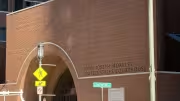
Harvard’s Science Center will soon be getting a new name. Earlier this month, the University announced that the building will be renamed Zimmer Hall, in recognition of a 2018 gift from the Zimmer Family Foundation of $100 million.
The name honors Alan Zimmer, the late father of Stuart Zimmer ’91. Alan Zimmer was an American neuroradiologist trained in Switzerland who helped research and develop the use of computer axial tomography (CAT) and magnetic resonance imaging (MRI) in the United States. Those technologies revolutionized medicine beginning in the 1970s and ’80s.
His son Stuart Zimmer studied mathematics at Harvard and in 2012 founded Zimmer Partners, a New York-based hedge fund and investment firm that now manages more than $5 billion in assets. Two of Stuart Zimmer’s children are also recent graduates of the College.
“We are profoundly grateful to Stuart and Jennifer Zimmer for their remarkable generosity,” President Alan Garber said in a press release announcing the Science Center name change. “They have strengthened Harvard’s ability to advance deeper scientific understanding and innovative scholarship, and they have been instrumental in helping us implement the recommendations of the Presidential Task Force on Antisemitism and Anti-Israeli bias to support our vibrant Jewish community at Harvard.”
The University also said that the Zimmers’ gift will help improve kosher dining on campus by expanding the menu and by making kosher dining available in Eliot House after renovations there are complete. (In 2024, Harvard separately expanded kosher options at Harvard Hillel, the Quad, and Annenberg Hall.) In a press release about the gift, Zimmer said, “In establishing kosher dining at Eliot House, we hope to ensure that every Jewish student feels genuinely welcomed and at home on campus.”
The Science Center was built in 1972 and designed by Josep Lluís Sert, who was then dean of the Harvard Graduate School of Design. The building houses the mathematics, statistics, and history of science departments, and has been undergoing a series of renovations since 2018. The upgrades include overhauling four teaching labs that support courses in physics, chemistry, and life sciences, as well as improvements to two lecture halls and the lobby.