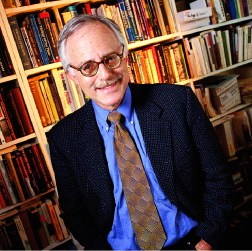
 |
| Lindsay Waters |
| Photograph by Jim Harrison |
Lindsay Waters is an uncommon bird. He is both the executive editor for the humanities of Harvard University Press perforce a generalist, seeing 10 or so "slow-cooked" books through publication each year and a productive scholar himself. At the University of Chicago he began as a medievalist, doing his doctoral dissertation on the fifteenth-century poet Luigi Pulci. He has written extensively about the late deconstructive literary theorist Paul de Man. He is author of a book, Against Authoritarian Aesthetics: Towards a Poetics of Experience, which he wrote in English but which was translated into Putonghua and published in Beijing by Peking University Press. And he has contributed to scholarly journals feisty articles chiding certain branches of the academy for requiring tenure candidates to churn out books that often are unreadable, uninspiring, and a burden to their authors, publishers, and audiences. As a publisher, he hopes to do his part to further develop ideas in analytic philosophy (espoused at Harvard by now-emeritus professors Hilary Putnam and Stanley Cavell) and to revitalize literary studies. "The humanities are deeply in the doldrums," he says, "but there is a way out. We've lost a sense of what it is that gets people turned on by art. We need to look at affect." He believes the humanities are at a "great moment," when young scholars, bucking a trend dominant for decades, are "paying attention to content and the effect that close reading has on them overall, body and soul." Waters is married and has three children. His older son is a musician, and he himself likes a good rock concert. Boston's The Pixies and Portland, Oregon's, Sleater-Kinney are favorite groups. He wants to see such contemporary arts brought into the curriculum.