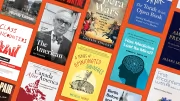
Reputation: Portraits in Power, by Marjorie Williams ’79 (PublicAffairs, $26.95). No matter who is elected, the president must contend with those permanently in power. No one ever portrayed such people better than the late Marjorie Williams, as this second collection of her work, edited by her husband, Timothy Noah ’80, vividly shows. The profiles—of the likes of Clark Clifford, James Baker, Lee Atwater, and Colin Powell—get at a Washington where, Noah notes, “the worst thing they can call you is a human being.” Williams showed why.
George, Being George, edited by Nelson W. Aldrich Jr. ’57 (Random House, $30). Two hundred ways, more or less, of looking at George Plimpton ’48, of the Paris Review and other ventures. We learn that his graduation, delayed by World War II service, was further postponed because the irate professor in his final-semester gut geography course (taken to fulfill a science requirement) flunked Plimpton for skipping every class.
Your Child’s Strengths, by Jenifer Fox, Ed.M. ’95 (Viking, $24.95). How to discover, develop, and use same, rather than dwelling on weaknesses, by the head of the Purnell School, in Pottersville, New Jersey.
Home Girl, by Judith Matloff ’80 (Random House, $25). Back from reporting in Moscow, the author buys a fixer-upper in West Harlem. This is the chronicle of what it means to build a “dream house on a lawless block.”
Words in Air: The Complete Correspondence between Elizabeth Bishop and Robert Lowell, edited by Thomas Travisano with Saskia Hamilton, RF ’01 (Farrar, Straus and Giroux, $40). The exchanges between the poetic giants, linking Lowell ’39, Litt.D. ’66, and Bishop for 30 years and spanning 458 letters. The period covered includes Lowell’s time teaching at Harvard, 1963-1977.
Physicists on Wall Street, by Jeremy Bernstein ’51, Ph.D. ’55 (Springer, $34.95). Somewhat accessible essays on options pricing and on why Wall Street has become a home for the physicists and other “quants” not employed at CERN’s Large Hadron Collider, plus “other essays on science and society.”
Patronizing the Arts, by Marjorie Garber, Kenan professor of English and of visual and environmental studies (Springer, $34.95). A meditation on the dual attitudes toward art in modern culture—patronage and condescension—and universities’ role in sustaining support for the artistic enterprise.
The Gridlock Economy, by Michael Heller ’84 (Basic Books, $26). The author, Wien professor of real-estate law at Columbia, explores how “too much ownership” complicates development and deployment of drug discoveries and new technologies, urban renewal, and more.
The Global Achievement Gap, by Tony Wagner, M.A.T. ’71, Ed.D. ’92 (Basic Books, $26.95). The codirector of the Change Leadership Group at the Graduate School of Education laments that American schools are obsolete, and focuses on how to retool them for the global information economy by emphasizing such core skills as critical thinking and collaboration.
A Great Idea at the Time, by Alex Beam (PublicAffairs, $24.95). Beam, a Boston Globe columnist, writes vividly about the Great Books program of the 1950s, tracing its formation in part to Harvard president Charles William Eliot’s “five-foot shelf” of Harvard Classics (reconsidered in this November-December 2001 article by Adam Kirsch and in its sidebar).
Frontiersman: Daniel Boone and the Making of America, by Meredith Mason Brown ’61, J.D. ’65 (Louisiana State University Press, $34.95). The author’s father, John Mason Brown ’23, wrote a Landmark (for teenagers) biography of Boone in 1952. From the late 1700s on, the Brown family had interacted with Boone in Kentucky. Now comes this clear, well-illustrated modern biography of an icon who helped bring about America’s “birth and transformation.”