Harvard's oldest alumni and alumnae

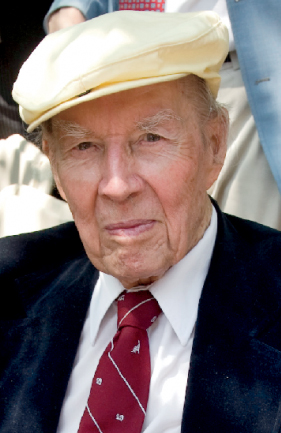
Marjorie Thomas '42 and Donald F. Brown '30 led the alumni parade on Commencement afternoon.

Marjorie Thomas and Donald F. Brown

Marjorie Thomas and Donald F. Brown | Photographs (from left to right) by Jim Harrison and Jon Chase/Harvard News Office

Photograph by Jim Harrison

George Barner

The oldest graduates of Harvard and Radcliffe present on Commencement day were Marjorie (Prince) Thomas ’42, 92, of Bedford, Massachusetts (accompanied by her husband, Edward Thomas ’41, who was celebrating his seventieth reunion), and Donald F. Brown ’30, Ph.D. ’55, 102, of Stow, Massachusetts. Both were recognized at the afternoon ceremony. (The oldest class representative was George Barner ’29, 102, of Kennebunk, Maine, who is three and a half weeks younger than Donald Brown.) Marjorie and Edward Thomas were married while she was still at Radcliffe College. Because he was in the U.S. Navy at the time, she left college to be with him, but more than three decades later she returned to campus “because I had made a promise to my mother that I would graduate.” She received her bachelor’s degree in 1978.

According to University records, the oldest alumni include: Halford J. Pope ’25, M.B.A. ’27, 107, of Hilton Head, South Carolina; Rose Depoyan ’26, 105, of Brockton, Massachusetts; Edith M. Van Saun ’29, 104, of Sykesville, Maryland; Priscilla Bartol Grace ’58, 104, of Woods Hole, Massachusetts; Ruth Leavitt Fergenson ’28, 103, of Rockville, Maryland; Dorothy P. Collins ’30, 103, of Hyde Park, Massachusetts; Rawson L. Wood ’30, 102, of Center Harbor, New Hampshire; Elliott C. Carter ’30, 102, of New York City; and Bertha Fineberg ’31, 102, of Gloucester, Massachusetts.
Related topics

You might also like

In 2004, a frenzy spread across Harvard Yard in days. Four billion users later, we are only just catching up.

The play Spare Parts is a contemporary fable about the quest to live forever.

David Battat promotes alumni engagement.

Most popular

The University will compensate families of those whose remains were sold and establish a scholarship to honor anatomical donors.

The program will focus on the U.S. Congress and the separation of powers in its first year.

The 1884 Cannibalism-at-Sea Case That Still Has Harvard Talking

The Queen v. Dudley and Stephens changed the course of legal history. Here’s why it’s been fodder for countless classroom debates.

Explore More From Current Issue

Three hands hold smartphones displaying social media profiles with likes and hearts.

Tell us about how social media impacts your daily life.

Caricature of a young man in front of red doors, wearing a green striped sweater.

In 1954, Gregory Corso moved into Eliot House. How he stayed there is a literary legend.

A smiling elderly man in glasses sits comfortably in a striped armchair.

Plus, veteran higher education leader Thomas Ehrlich reflects on university curricula for his 70th reunion