A Harvard Business School exhibition on early trade with China

An exhibition from Harvard Business School's historical library collections documents the first wave of U.S. trade with imperial China.

Tea production in China, c.1790-1800

Tea production in China, c.1790-1800 | Image courtesy of the Peabody Essex Museum, Salem, Massachusetts.

Augustine Heard, of Ipswich, Massachusetts, built on his experience as a brig captain to found his own trading firm to do business in China.

Augustine Heard, of Ipswich, Massachusetts, built on his experience as a brig captain to found his own trading firm to do business in China. | Image courtesy of the Harvard Business School

A receipt for textiles (from the Heard Family business records)

A receipt for textiles (from the Heard Family business records) | Image courtesy of the Harvard Business School

The merchant Hoqua, portrayed by George Chinnery, c.1830, amassed a $26-million fortune, placing him among the world’s richest men.

The merchant Hoqua, portrayed by George Chinnery, c.1830, amassed a $26-million fortune, placing him among the world’s richest men. | Image from Art Resource/©the Metropolitan Museum of Art

Silk samples, c.1850

Silk samples, c.1850 | Image courtesy of the Baker Library Historical Collections/Harvard Business School

The Heard Company flag

The Heard Company flag | Image courtesy of the Ipswich Museum

The company&rsquo;s 700-ton steamship the <i>Fire Dart</i>, commissioned in 1859-1860 for the Yangtze River trade after the Second Opium War. It flies the Heard colors.

The company’s 700-ton steamship the Fire Dart, commissioned in 1859-1860 for the Yangtze River trade after the Second Opium War. It flies the Heard colors. | Image courtesy of the Ipswich Museum

Aymon. "Les quatres fils" [The Four Heard Brothers.]

Aymon. "Les quatres fils" [The Four Heard Brothers.] | Image courtesy of the Ipswich Museum

Pedder Street Clock Tower and Hongkong Hotel, Central District. Victoria Harbour.

Pedder Street Clock Tower and Hongkong Hotel, Central District. Victoria Harbour. | Image courtesy of the University of Hong Kong

Belcher, Edward. Canton and its approaches, Macao and Hong Kong. Map. London: George Cox, Jan. 1st 1853

Belcher, Edward. Canton and its approaches, Macao and Hong Kong. Map. London: George Cox, Jan. 1st 1853 | Image courtesy of the Harvard Map Collection/Harvard College Library

[extra:Extra] 

Images from the exhibit, beyond those that appeared in print, appear in the gallery at top. 

The earliest United States trade with China, it may be hard to remember, began just after independence from Great Britain. It initially involved such goods as tea and textiles, and amounted to tens of thousands of dollars, rather than trillions. The addictive good of the era, shamefully, was opium (a major component of Chinese imports), rather than the torrent of Apple consumer gadgets flowing outward today. Unlike the great European joint-stock enterprises—the Dutch East India Company and its British counterpart—the American traders were New England entrepreneurs who set up private firms or merchant syndicates.

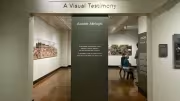
A Chronicle of the China Trade, an elegant exhibit at Baker Library drawing on Harvard Business School’s historical collections (through November 17, and online at www.library.hbs.edu/hc/heard), documents this commerce through the remarkable records of Augustine Heard & Co., from 1840 through 1877 (just one of the library’s collections of such materials). The documentary evidence, complemented by American artifacts and materials on loan from Hong Kong and Shanghai, details the growth of the family business and the swelling volume of cotton, silk, porcelain, and other goods crossing the ocean. It explores rapid institutional change, from the Chinese system of limiting trading to licensed hong monopolies under imperial control, to the forced opening of so-called treaty ports (after the Opium Wars) and the rise of compradors who managed business as trading-house employees. It follows the spread of business from coastal enclaves into China’s interior (a pattern repeated during the past three decades); the physical and social evolution of trade communities; the deployment of game-changing, speedy new technologies (clippers and steamships, antecedents to the modern cargo jet, and the telegraph); and the lubricating effects of new banking services, credit instruments—even (tea) crop futures. And yes, fortunes were made (and lost)—not only by the Heard enterprise but also by Chinese traders who proved utterly adept at business.


You might also like

Tk tk Iran

Artist Azadeh Akhlaghi reconstructs moments of Iranian political upheaval in a series of meticulously staged images.

George Washington’s Sash on Display at Peabody Museum Starting May 25

A famous American fashion statement helps bring Revolutionary history to life.

Lafayette’s Unexpected Gift to George Washington: Pheasants

The two birds will be on display at Harvard this summer.

Most popular

Meet Harvard’s 2026 Student Commencement Speakers

Two undergraduates and a Ph.D. candidate will address the graduating class on May 28.

Harvard Honors Its Oldest Alumni

At 97 and 101, Linda Cabot Black ’51 and William “Bill” Dubey ’46 led the way on Alumni Day.

Graduates John Lithgow, Bill Rauch, and Bess Wohl took home prizes on Sunday night.

Explore More From Current Issue

Historical scene depicting a parade with soldiers and a town square in the background.

When the Revolution Hit Cambridge, Harvard Moved to Concord

College students broke hearts and windows during their year in exile.

Woman in historical dress standing in front of green foliage, smiling brightly.

This Harvard Graduate Brings Women of the Revolution to Life

Historical reenactor Lauren Shear reveals tricks of the trade for playing Tory loyalists, Revolutionary poets, and more.

Historical scene in colonial Boston depicting British soldiers confronting civilians, with smoke rising, in a city street.

Houghton Library Displays Revolution-era News and Propaganda

A new exhibit reveals how early Americans learned about the war.