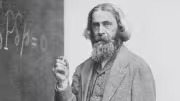
Harvardiana. The Selected Letters of John Kenneth Galbraith, edited by Richard P.F. Holt (Cambridge, $34.99). Economists today may look down on Galbraith’s economics—but can any of them write as he did? Includes the classic exchange with Dean Henry Rosovsky on the selling of Faculty of Arts and Sciences indulgences. Man of the Hour: James B. Conant, Warrior Scientist, by Jennet Conant (Simon & Schuster, $30); a massive biography of Conant ’14, Ph.D. ’16, LL.D. ’55, whose consequential Harvard presidency seems only an episode in a life also devoted to public service during World War II and after—both in developing the most fearful weapons of mass destruction and then to reining them in. Uncompromising Activist, by Katherine R. Chaddock (Johns Hopkins, $24.95), is a life of Richard Theodore Greener, A.B. 1870, the first black graduate of Harvard College—a prelude to diplomatic service in Vladivostok, a law deanship, and complications about “passing” in a society sharply demarcated by color lines.
Akhil Sharma, J.D. ’98, took 13 years to write his autobiographical novel Family Life. Now he has followed up in a fleet three with his collection A Life of Adventure and Delight (W.W.Norton, $24.95). One story, “Surrounded by Sleep,” returns to that novel’s central trauma, of a young boy suffering brain damage after hitting the bottom of a swimming pool; the rest concern characters full of submerged longing. Sharma’s portraits of stilted courtships and childhood disappointments are finely observed, and surprisingly funny.
Just a Journalist, by Linda Greenhouse ’68 (Harvard, $22.95). This modestly titled, succinct memoir and reflection (concerning the modestly subtitled subjects, “On the Press, Life, and the Spaces Between”) contends with the boundaries of journalism, citizenship, and balance—in a new era for each. The author, a former Overseer and now lecturer in law at Yale, writes with the clarity that distinguished her New York Times coverage of the Supreme Court and American law.
The Development Dilemma: Security, Prosperity, and a Return to History, by Robert H. Bates, Eaton professor of the science of government and professor of African and African American studies (Princeton, $27.95). A distinguished scholar of development, or the lack thereof, in Africa, where he has often and long put his boots on the ground, looks back into the divergent historical paths of England and France to examine state security and the political role in decisions about the use of wealth in his effort to tease out, succinctly, trajectories toward prosperity.
In time for the World Series, Smart Baseball, by Keith Law ’94 (Morrow, $27.99), senior baseball writer/analyst for ESPN, equips readers to appreciate the beauties of UZR, WAR, and other fancy metrics—often with vivid humor (on “small ball” and bunting: “so called, I think, because it produces smaller numbers on the scoreboard”). Or, you can revert to old-fashioned fandom.
Other cultures. A New Literary History of Modern China, edited by David Der-Wei Wang, Henderson professor of Chinese literature and of comparative literature (Harvard, $45), contains scores of essays on the field—engagingly including, for nonexperts, film, theater, and popular song. Pious Fashion: How Muslim Women Dress, by Elizabeth Bucar ’96 (Harvard, $29.95), looks seriously at the meanings of clothing choices, extending far beyond the political values and controversies assigned to veiling in, say, Europe or parts of the United States. The author is associate professor of philosophy and religion at Northeastern. Tokyo Boogie-Woogie: Japan’s Pop Era and Its Discontents, by Hiromu Nagahara, Ph.D. ’11 (Harvard, $35), examines a genre, and era, and Japan’s postwar transition into a middle-class, consumer society.
The Shadow in the Garden, by James Atlas ’71 (Pantheon, $28.95). The biographer (Saul Bellow, Delmore Schwartz) and publisher of biographies now delivers “A Biographer’s Tale” (the subtitle) on his own life’s path. Fittingly, he writes of Edmund Wilson, “I wonder if it might have been the hybrid of biographical and autobiographical portraiture—the fugitive presence of the writer in the writing—that I admired.”
Paris in the Present Tense (Overlook, $28.95) is the new novel by Mark Helprin ’69, A.M. ’72, who was memorably profiled in “Literary Warrior” in these pages (May-June 2005, page 38).
The First Serious Optimist, by Ian Kumekawa (Princeton, $35). The author, a doctoral candidate in economic history, delivers an intellectual biography of A.C. Pigou, bringing the British economist out of the shadow of Keynes and focusing attention on the origins of welfare economics, ideas such as spillovers and externalities, and measures like a carbon tax to address the latter.
Poetic trio. Farrar, Straus and Giroux has published Half-light: Collected Poems 1965-2016, by Frank Bidart, A.M. ’67 ($35), including a new grouping, Thirst, in which the subject is increasingly the poet himself. The Surveyors (Knopf, $27) is a new group of poems by Mary Jo Salter ’76, who sees much in life anew, like the narrator of “Bratislava”: (“So I’m still alive and now I’m in Bratislava./…That’s funny. I’d assumed my travel companion/through life would be my husband…”). Tom Jones ’63—former human-rights lawyer and teacher, now poet and photographer—has gathered some of the latter work in Beyond Existentialism (FootHills, $20); classmates from his decade may feel viscerally the opening of a poem from Vietnam: “Eleven months and seven days/as a grunt in the jungle/feet rotting…”
Ways of seeing. Chromaphilia: The Story of Color in Art, by Stella Paul ’77 (Phaidon, $49.95), is a breathtaking survey of materials and colors (separate chapters for each) in art, by a former chief exhibitions educator at the Met. From Photon to Neuron: Light, Imaging, Vision, by Philip Nelson, Ph.D. ’84 (Princeton, $49.50 paper), based on a course by the University of Pennsylvania physicist, joins physics and neuroscience—a suggestion of the interdisciplinary gaps and opportunities just within the sciences. Combining the two volumes implies further gains from collaborations between sciences and humanities, for those with the skill to understand—and then to translate for curious civilians.