By all means. Nathaniel Phillips Carleton ’51, Ph.D. ’56, a physicist-turned-astronomer who practiced his craft for many years at the Harvard-Smithson- ian Center for Astrophysics, died on February 25, at age 90. He had an early hand in arraying smaller (but not small!) telescopes to achieve the light-collecting power of impossibly larger single instruments (the feature now at the center of next-generation machines, like the Giant Magellan, described in “Seeing Stars,” May-June 2013, page 32)—work that took him and his wife, Kay, to mountaintops high above the Arizona desert, often. As a scientist, he progressed from studying Earth’s atmosphere to observing the distant planetary equivalents.
Locally, he appears to have been dedicated and inventive in ways that might inform the contemporary academic community. According to his obituary notice, Carleton raised his family in Carlisle, riding into Cambridge by motorcycle. He also lived for a time in a houseboat in Boston Harbor. And he built a 42-foot catamaran that he and Kay sailed along the East Coast. There you have it: innovative modes of transportation, and outside-the-box residential arrangements—solutions to the two problems that most complicate the lives and strain the budgets of Harvard faculty and staff members today.
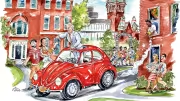
Home-from-Home. With construction work on Adams House renewal now extended to August 2024 (see Brevia, this issue), its wry faculty-deans-in-exile have affixed this sign (see above) to their own swing space, on Prescott Street—a few blocks northeast of their regular quarters.
Clothing codes. While worrying about global warming during a weirdly mild winter (gloomy thoughts heightened one February Sunday spent raking the lawn in a cold northern suburb, when shoveling the driveway would have been seasonally in order), Primus found some solace in the low level of the CGI. This little-known metric—Primus invented it—is tightly tied to the class differences visible among the young persons studying in Cambridge.
The Canada Goose Index (for such it is) unscientifically registers how many people who look to be undergraduates are wearing the eponymous parkas to keep off the chill—at $500 or so for a jacket to more than twice that for a long coat with a ruff of real fur: all readily identifiable by the logo patch. A moment’s observation outside a Harvard Square-priced coffee shop during the prior, colder, winter yielded an initial CGer—who was promptly joined, seriatim, by four colleagues similarly attired: enough coat to qualify as a decent-sized capital investment.
Winter outerwear is of no intrinsic interest. But as assistant professor of education Anthony Abraham Jack points out in The Privileged Poor (see “Adjacent but Unequal,” March-April 2019, page 26), on elite campuses, “clothes quickly become a proxy for class”—especially as perceived by the growing cohort of lower- and medium-income matriculants who have not resided among, or perhaps even met, much wealthier peers before. “[I]f one student sports an $895 Burberry raincoat while another wears a $69.99 coat from H&M,” Jack writes, something real has been seen—and absorbed. One Jack interviewee could not believe the price of North Face coats, compared to her “ZeroXposur, which is like a Sears brand.” And during his research, North Face gave way to the far more expensive Canada Goose as the new “brand of choice on campus for those who could afford it.” Are $2,000-plus Monclers next?
There is nothing encouraging about climate change. Yes, the Hamamelis x intermedia ‘Arnold Promise’ witch hazels brightened Widener, Mass Hall, and other campus nooks on drab days this February. But their stringy yellow blooms would have been equally lovely on schedule, nearer winter’s traditional end. If the class chasms echoing on campus from the larger society are lessened ever so slightly along the way, that’s to the good. But so would be good old-fashioned New England winters, with students paying more heed to function than fashion when they zip up against the cold.