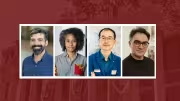
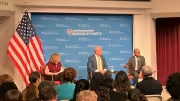
“I’m really here today, not just as the president of Harvard, but also as the child of immigrants,” Lawrence Bacow said Friday, joining nearly a dozen other speakers—including U.S. senators Ed Markey (Massachusetts) and Angus King (Maine), and Massachusetts congresswoman Ayanna Pressley—taking part in a New England-focused virtual summit to advocate for comprehensive immigration reform. Several hundred listeners logged on to hear testimony from elected officials, businesspeople, activists, DACA recipients, and essential workers. Nirva Sajous, an undocumented immigrant from Haiti with temporary protected status who is a health-care worker at the Dana Farber Cancer Institute in Boston and at an assisted-living senior center, talked about the extra stress and insecurity that the pandemic has added to her life. Javier Juarez, a DACA recipient, spoke about his journey from Lima, Peru, to college at Brown University and a job at an advocacy organization for immigrants and refugees.
The event was co-sponsored by several New England-based immigration organizations, including the Massachusetts Immigrant & Refugee Coalition and the American Business Immigration Coalition, which hosted the summit. Both Markey and Pressley made extended pitches for the policy reforms they see as necessary, with Markey vowing to re-introduce his New Deal for New Americans Act, first unveiled in 2019, which offers a pathway to citizenship for the estimated 11 million people living without legal status in the United States. Pressley emphasized the inequality and harm that undocumented immigrants face, including in her own district that includes part of Cambridge. That inequality has grown even more stark under the pandemic’s unevenly borne toll of death and sickness and economic devastation. “So we find ourselves,” Pressley said, “in this unprecedented public-health crisis that has wreaked havoc on our most vulnerable communities.” Later, she added, “It’s not just their work that is essential; their lives are.”
Bacow echoed many of those remarks. Recalling his parents’ journeys to the United States as European refugees after World War II, he praised the “ambitions and achievements” of undocumented students at Harvard. He called for swift and sweeping changes to American immigration policies that are “failing the undocumented,” adding, “Congress must end the uncertainty and provide the broadest possible relief for those who are undocumented, including those who enjoy temporary protected status. By acting now, I hope we can create momentum to build a U.S. immigration system that is smart, compassionate, and fair.” American higher education has a particular stake in the immigration debate, he emphasized: “All of our colleges and universities thrive when the world’s best have the opportunity to join our community.” Fully 35 percent of Harvard’s faculty members, he added, were born in other countries, as were five of the University’s 13 Nobel laureates of the past 25 years.
“The United States has been a top destination for international students and scholars, but this preeminence cannot be assured,” Bacow warned. “Our fiercest economic competitors aspire to have what we have, with their governments offering far more favorable treatment to international students, international scholars.” College administrators in this country contend with immigration laws that were last overhauled 30 years ago. “And it's beginning to take a toll,” he said, “with consecutive years of declining enrollment and reduced stay rates for advanced-degree holders, as graduates choose opportunities elsewhere in the face of uncertainty here. After an unprecedented period of hostility towards immigrants, towards refugees, we're at a critical turning point. We need Congress to pass legislation, to put the undocumented on a path to citizenship, and to win back international students and scholars to avoid lasting damage to our national competitiveness, security, and prosperity.”
Returning again to the freedoms and opportunities his own family sought and found as refugees, Bacow spoke of the responsibility that prosperity carries with it. “The time is now,” he said. “It is our economic and moral imperative. And it cannot wait.”