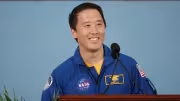
It’s been a difficult couple of years for American institutions of public health—with massive cuts to federal research funding and national agency budgets, a shrinking of the public health workforce, the dismantling of U.S. Agency for International Development and dozens of smaller domestic programs, the U.S. withdrawal from global health organizations, and, most recently, worrying outbreaks of deadly infectious diseases. Amid all of this, Wednesday’s convocation ceremony for the Harvard Chan School of Public Health, which celebrated the field’s past accomplishments and insisted on its future promise, felt like an act of joyous defiance.
“The fact is, public health can and does achieve extraordinarily ambitious goals,” Dean Andrea Baccarelli said in his opening remarks. “No field touches more lives.”
Throughout his speech, Baccarelli spotlighted several areas of the graduates’ expertise, from data science to epidemiology to nutrition to environmental health. He praised the eight Chan School alumni who have served as directors of the Centers for Disease Control (CDC), including William Foege, M.P.H. ’65, “who developed the strategy that eradicated smallpox, the only human disease ever eradicated.” Baccarelli excitedly told global health graduates about longtime Chan School lecturer Richard Cash, who in the 1970s developed a procedure called oral rehydration therapy to treat cholera and diarrheal diseases.
“It was an inexpensive solution of sugar, salt, and water,” Baccarelli explained. “Simple! It’s saved tens of millions of lives ever since. Tens of millions! That’s the power of global health.”
Student speaker Rajeshwari Subramanian, who is graduating with a master’s degree in health and social behavior, offered a personal reflection of how her interest in public health was shaped by a traffic accident that paralyzed her father when she was a child.
“Our home in Mumbai became not just a home, but a system,” she said, “of caregiving, of resilience and improvisation.” The family fashioned a wooden board attached to an old microphone stand into a table so her father could read again. “It wasn’t sleek or complex,” she said. “But it gave him back a piece of his world.”
The outside world was harsher. “I grew up watching my mother become a full-time caregiver and my father navigate a world that quietly told him, time and again: ‘You were not considered when this was built,’” she said. “I noticed the buildings without entry points, the stares that lingered a second too long. The small frictions that kept adding up to a life made harder than it needed to be.”
Eventually, her public health training gave her a way to think about and act on these observations.
“Public health is where people care,” Subramanian said. “Truly, deeply care.
Not in a general, well-intentioned way—in a specific way. We care about the air in a neighborhood, whether a child is raised with love, or whether someone can afford healthy food.”
Everyone, she said, carries their own individual lens on their surroundings, informed by their personal experiences of public health. “That lens,” she said, “is not just how you see the world. It is how you will change it.”
Keynote speaker Rochelle Walensky, M.P.H. ’01—another of those eight CDC directors, who led the agency during the COVID-19 pandemic—combined historical examples of public health breakthroughs with an upbeat call to action. A physician and scientist who was a Harvard Medical School faculty member until 2020 (when she departed to lead the CDC), she recounted how in 1777 George Washington had ordered all Continental Army troops to be inoculated against smallpox. It was the country’s “first vaccine requirement,” Walensky said, and “a move that likely changed the course of history.”
She also told the story of physician and epidemiologist Alexander Langmuir, who created the CDC’s Epidemic Intelligence Service, which became a worldwide model for disease reporting, detection, and response. It spawned “a global network of people dedicated to finding outbreaks early, understanding them quickly, and protecting the health of millions,” she said.
Finally, she described the work of Mona Hanna-Attisha, the pediatrician who in 2015 documented—and publicized—the fact that the drinking water in Flint, Michigan, was contaminated with lead.
“Public health has never waited for perfect times,” Walensky told graduates, “only for imperfect people, as we are, willing to step forward. And now, that responsibility—and, I believe, that great gift—belongs to you. Trust that you are more ready than you think.”