The night before Joseph E. Murray, M.D. ’43, took on a revolutionary surgical challenge, he prayed. It was Christmas week in 1954 and, as a practicing Catholic, he thought it an auspicious time to give a patient the chance for renewed life. Yet the pending operation, the first-attempted live-kidney transplantation, had plenty of critics. It was a radical surgery and risks ran high for both patient and donor.
Murray and the other Harvard-affiliated doctors who brought medicine to this juncture had encountered a wall of moral and religious outrage. Many viewed operating on the donor—a healthy person—as unethical. But Murray argued that scientific, religious, and ethical beliefs could dovetail by exercising one’s God-given attributes of “curiosity, imagination, and persistence.”
Raised in Milford, Mass., Murray graduated in Harvard Medical School’s abbreviated World War II class of 1943B, with all members drafted into military service. After a nine-month surgical internship at Boston’s Peter Bent Brigham Hospital, the U.S. Army assigned him to Pennsylvania’s Valley Forge General Hospital, a center for battle injuries. “We saw many burns and were using skin grafts to save lives,” he explained during a later interview. “I was interested in the biology of transplants, and why it was that a piece of skin grafted from one’s own self would live, but from another person wouldn’t.” He was intrigued by a lone case where, curiously, the expected tissue rejection did not take place; it was a skin graft between homozygous (identical) twins.
Hoping to utilize this scrap of data, Murray, by then married with children, returned to Peter Bent Brigham Hospital. Setting aside his budding talent for plastic reconstructive surgery, he joined the new transplant team of visionary medical chief George Thorn, Hersey professor at Harvard Medical School, and his young colleagues, surgical chief Francis Moore ’35, M.D. ’39, S.D. ’82, and nephrologist John P. Merrill ’42, a perfector of the dialysis machine.
Following a century of attempted transplants from animals and cadavers to humans that yielded minimal survival rates (save one lasting for six months by team member David Hume ’40), the group was determined to crack the code of sustained organ viability. Murray revealed in his autobiography that despite hospital support, many outside professionals considered it a “fringe project” run by “a bunch of fools.” Yet the team persevered.
“We started with kidney transplants between unrelated persons,” Murray said of his early operations using deceased donors, “but they were rejected [by the body’s immune system].” So, he began experimental self-transplants on living dogs, mice, rabbits, sheep, and horses, honing his surgical technique. (Murray would remove a kidney from a dog, see how the animal fared with one kidney, and then transplant back the removed kidney to see if still functioned.)
“We wanted to get the consensus...and to ‘do no harm.’”
In 1954, in a plot twist that would have been derided as overly contrived in a work of fiction, a 23-year-old named Richard Herrick arrived at the hospital suffering from final-stage renal failure. However, he disclosed remarkable information: he had a healthy identical twin, Ronald. Murray, recalling the army skin-graft success between twins where “genetic immunological compatibility” existed, eagerly endorsed a twin-to-twin kidney transplant attempt. Excitement mounted, with Murray designated as surgeon.
But enthusiasm soon soured to consternation. After Murray visited a police station to verify Richard and Ronald’s identicality through fingerprinting, word of the proposed transplant leaked and radio newscasts warned of “a daring operation.” Disapproval escalated among concerned scientists and doctors, and in religious circles. Murray wrestled with the moral dilemma, seeking input from clergy members, jurists, and outside medical specialists. “We spoke with the family many times,” he affirmed. “We wanted to get the consensus…and to ‘do no harm.’” This inclusive approach eventually garnered uneasy approval. As Richard Herrick neared death, Murray, understanding the importance of a flawless transplantation, conducted a “dry run” on a cadaver.
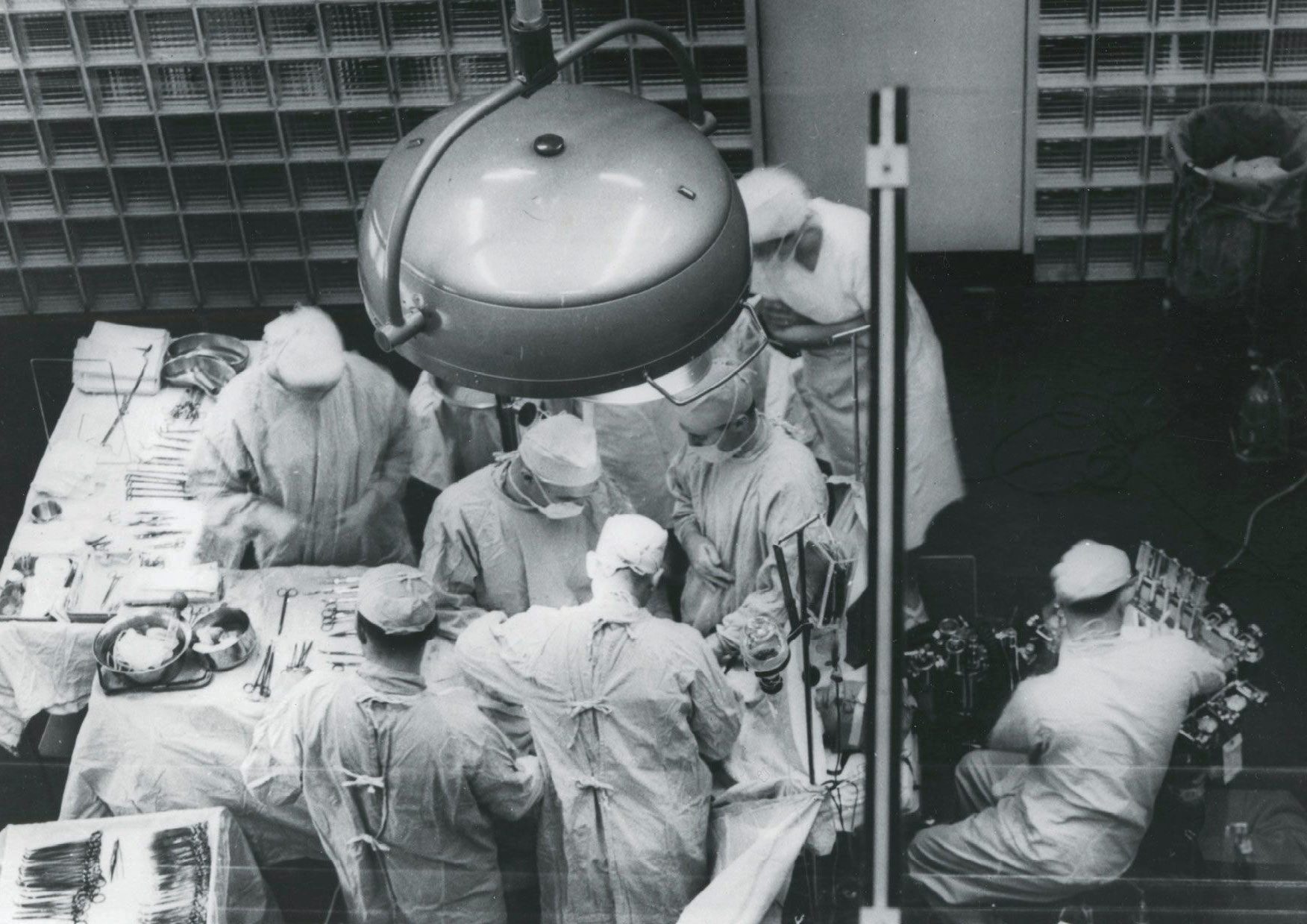
On December 23, 1954, the simultaneous Herrick surgeries commenced in adjacent operating rooms. Chief of urology J. Hartwell Harrison (later the recipient of a 1965 honorary master’s degree from Harvard) completed the donor nephrectomy and within 90 minutes Murray implanted the new kidney. Soon, to everyone’s profound relief, Ronald’s kidney, now attached to his brother, was pink and engorging. “We knew it was a success,” said Murray. “The next day the kid was hungry, with a sparkle to his eyes.” Ronald’s continued stability doubled the team’s gratification. (Richard lived for eight more years, becoming a husband and father; Ronald suffered no ill effects, dying at age 79.)
Accolades rained down and the pioneering surgeon pressed forward with dozens more successful kidney transplants, still between twins. Finally, experiencing a “eureka” moment, Murray achieved the holy grail of viable transplantation between unrelated individuals in 1962. He administered a new cancer-fighting drug with immunosuppressive properties to the kidney recipient; it disabled the patient’s immune rejection response, enabling organ survival. This breakthrough was foundational across the globe, the key to transplant advances that today grant extended life to 173,000 organ recipients annually.
By 1970, Murray, still drawn to plastic reconstructive surgery, had ceased performing transplants to institute a cranial/facial program for children with congenital deformities at Children’s Hospital. He retired in 1986 as chief of plastic surgery emeritus at both Children’s and Brigham and Women’s Hospitals.
In retirement, the amiable surgeon enjoyed attending transplant survivor gatherings, “getting revivified” on Martha’s Vineyard with his family of eight, finding beauty in William Blake’s poetry, and “swapping ideas” with medical students. Heralded internationally as “the father of transplantation,” he welcomed to his Wellesley, Mass., home distinguished admirers and aspiring researchers seeking a primary-source account of history’s groundbreaking transplant. Murray consistently downplayed his role. “It was just another day,” he’d say. “A part of our lives.” But the humble doctor’s peers begged to disagree. In 1990, they awarded him the Nobel Prize in Medicine.