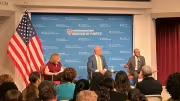
At a Harvard Kennedy School forum on Thursday, former House Speaker Paul Ryan warned that Congress is steadily losing power to the executive branch—an erosion he blamed on both parties. Ryan also addressed conservative critiques of DEI and “wokeism,” alongside divisions within the Republican Party.
Speaking at the Institute of Politics alongside Anthony Foxx, director of the Center for Public Leadership, Ryan sought to unpack conservative criticisms of “wokeism.” He argued that the core objection is not to diversity or inclusion themselves, but to the concept of equity.
“Diversity and inclusion are really important principles,” Ryan said. “It’s the equity in the middle [of DEI] that is the issue.” Goals such as ending racism and combating antisemitism, he added, have been folded into a broader ideological framework that many conservatives experience as coercive. “They’ve been told that to pursue these really important ideas…you have to buy into the progressive ideological package wholesale.”
Ryan applied a similar analytic lens to conservatives’ hesitation toward environmental policy, breaking down the acronym ESG (environmental, social, and governance criteria, an investment strategy used to evaluate companies) in a similar fashion.
He argued that while some parts of ESG can be measured objectively, others become ideological. “The environment is quantifiable,” Ryan said. “It’s metric driven. You can measure more carbon, less carbon.” Just as clear metrics for planetary health exist, business schools can define what good governance looks like.
However, he argues that the “S” in ESG becomes more subjective and turns into what he describes as “a walk down progressive lane.” In his view, conservatives see these issues as being “hijacked…in service to an ideology,” When asked by Foxx whether there is a conservative version of environmental and social priorities, he says yes, describing an approach rooted in technology and energy independence; specifically, advancing nuclear energy, fusion, and waste recycling, rather than restricting energy production.
Ryan also drew a sharp distinction between his own political philosophy and that of today’s Republican Party. “The current party is not my variant,” he said. “They’re the Trump, MAGA 2.0 version.” What drives the GOP today, he argued, is better described as nationalist populism than conservatism. “I don’t even want to call it conservatism,” he said. “Soil nationalism doesn’t work.”
For Ryan, conservatism is rooted in a conception of the United States as an idea grounded in liberty, self-determination, and equality of opportunity. “Rights are natural, predetermined by our creator, and the government’s job is just to protect those rights,” he said. “If you believe America is an idea, then that means anyone can come and enjoy the idea, as they should.”
He was equally critical of the left, arguing that both parties have drifted toward a kind of moral relativism, where outcomes justify methods and political opponents are treated as enemies. “Neither party is giving the country what they deserve,” he said.
Returning to what he sees as the nation’s most pressing challenge, Ryan warned that Congress has steadily ceded authority to the executive branch. “I do think this executive branch is encroaching,” he said, adding that the trend predates any single administration. “I actually sued both Trump and Obama” as Speaker, he noted, on Article One grounds.
Ryan traced part of that erosion to changes in the federal budget process. The post-Watergate reforms of 1974 were intended to reassert congressional authority, but the system has since collapsed. “The budget process is totally different,” he said, describing today’s appropriations system as “irreparably broken.”
For Ryan, the issue is not partisan, but constitutional. Referencing the fact that filmmaker and historian Ken Burns was also on campus this week, Foxx asked how the nation’s founders might view the current moment. “The legislative branch is actually the strongest,” Ryan said, invoking Article One, Section 8 (which enumerates the specific powers granted to Congress, including taxation, borrowing money, coining money, regulating commerce, declaring war, and raising armies), and “the power of the purse.”
The idea was always “a healthy tension…and the framers believed in this healthy tension,” Ryan said. Yet, he added, “Congress could do a lot more” to “defend its ground.”
Turning to fiscal policy, Ryan warned that the national debt has reached what he sees as a dangerous level. He pointed to the federal government’s projected interest payments (nearly $1.6 trillion in fiscal year 2026) and argued that changes to major government programs are unavoidable. “Social contract programs are the driver of our debt crisis,” he said, pointing to Medicare and Medicaid.
When Foxx asked Ryan how he would remedy the debt, the former Speaker called for a larger role for market-based solutions, arguing that competition and innovation can help control costs. More broadly, he challenged Democrats to accept the idea that “markets work best” as a way to sustain programs like Medicare, Medicaid, and the Affordable Care Act.
Reflecting on his own career, Ryan said he never sought the speakership. “Not a fun job,” he said, noting that his interests lay more in economic policy than managing the House. His advice to students interested in public policy was pragmatic: “A lot of people in the TikTok economy think you can fake it till you make it,” he said. Instead: “Build strong habits, work hard, and develop expertise in a specific area.”