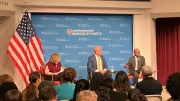
Should world powers treat violent actors as criminals or as enemies? At an Institute of Politics event at Harvard Kennedy School (HKS) on April 6, human rights lawyer Luis Moreno-Ocampo—the first prosecutor of the International Criminal Court (ICC)—argued in favor of the criminal justice approach. But he noted that more than two decades after its founding, the ICC’s influence remains uneven, as evidenced by the ongoing wars in Ukraine and Iran, as well as the U.S. military operation in Venezuela this January.
“The ICC is a tool states are not using,” Moreno-Ocampo said, citing a basic structural problem: the court has no enforcement arm and relies on member states to carry out arrests. “There’s no global police,” he said.
The ICC, created in 2002 under the Rome Statute, was established to prosecute individuals for committing genocide, war crimes, crimes against humanity, and the crime of aggression. At least in theory, the court introduced legal accountability into the realm of international conflict.
The court works by investigating suspected crimes “of sufficient gravity,” then issuing a voluntary summons or arrest warrant for a suspect—who then risks being detained if they travel to any of the 125 countries that signed the Rome Statute. Leaders indicted by the court—such as Russian President Vladimir Putin, who faces charges of war crimes for unlawfully deporting civilian populations in Ukraine—face restricted travel and isolation, which should serve to limit their diplomatic and international power.
But in practice, many world leaders have chosen to treat individual adversaries in ongoing global conflicts as “enemies,” rather than criminals, Moreno-Ocampo noted. Taking Venezuela as one example, he described a unique procedural challenge. The U.S. military operation there targeted alleged drug-trafficking networks through maritime strikes on suspected cartel-linked vessels.
“You cannot be in a war with a drug dealer group,” Moreno-Ocampo said. “They are criminals, not enemies in combat.” Treating such groups as wartime enemies, he argued, risks justifying military responses where law enforcement would be more appropriate, blurring legal boundaries and escalating violence.
The war in Iran, he said, illustrates a different limitation of the ICC. The court can only intervene to prosecute alleged crimes if a country has ratified the Rome Statute—and Iran has not. However, there is precedent for ICC involvement in situations where a state is not a party to the statue. For instance, the ICC gained jurisdiction over alleged Russian crimes in Ukraine because they occurred on Ukrainian territory, despite Russia never having ratified the treaty.
Kathryn Sikkink, Ryan family professor of human rights policy at HKS, who moderated the conversation, asked Moreno-Ocampo what international criminal law can do to address allegations of crimes against humanity and war crimes that dominate news coverage of the ongoing U.S.-Iran war. (The HKS event took place before U.S. President Donald Trump made a threat on Truth Social to destroy civilian infrastructure in Iran, which he later withdrew when the parties entered a two-week ceasefire.)
Moreno-Ocampo said that even if the ICC determined that crimes were committed by any party to a conflict, holding a nation’s leadership accountable would depend on the specific nature of crime. He also noted that additional complications exist when it comes to applying international law in situations where a nation starts a war to preempt an imminent threat against itself.
Rather than pursuing a war in the name of global security that risks “opening Pandora’s box,” Moreno-Ocampo called for new institutional approaches, including establishing a dedicated court for terrorism. For 5,000 years, he said, war was a mechanism for resolving conflicts between societies. “After the Cold War, there was hope that this era had ended,” Moreno-Ocampo said.