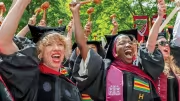
Each year, Harvard taps three degree-earning students—two undergraduates and one graduate student—to address the University community during Commencement exercises in Harvard Yard. Speakers for the 375th commencement ceremony, selected from dozens of applicants and multiple rounds of auditions, include a physics student and classical guitarist; an economics and classics major set to embark on a summer tour with her a cappella group; and a Ph.D. candidate delving into political upheaval across the world. Before they deliver their speeches (from memory!) on May 28, get to know them below.
Noah Eckstein ’26 (Senior English Orator)
Some people wear many different hats; Noah Eckstein has a metaphorical closet full of them. An undergraduate physics concentrator, Eckstein is working on a concurrent Harvard master’s degree in theoretical physics and will continue his graduate work in the fall. Additionally, he is a student in the dual degree program between Harvard and the Berklee College of Music, taking courses in scoring for film, TV, and video games and continuing his lifelong training as a guitarist.
Thanks to his musical background, Eckstein has plenty of experience in front of crowds. Until now, though, he’s never given a speech—much less one in front of 30,000 people.
“I’ve never done any public speaking,” he says. “I’ve been playing guitar since I was five years old and I’ve performed a ton, so I know how to deal with the nerves. But this is a different game.”
Eckstein’s family background is multifaceted in a different way, one that served as the inspiration for his Commencement speech. He grew up Jewish in Lubbock, Texas, with a mother who had converted to Judaism from Christianity. One of his grandfathers was a Holocaust survivor; the other a Pakistani Muslim.
That swirl of identities and ideologies, he says, made the kind of rigid, polarized thinking he sees in society and public debate pretty much impossible in his family. Eckstein’s speech makes the case that, too often, the world is split into two sides, with each loudly debating but seldom listening to the other. Those sitting on opposite sides of any issue—communism vs. capitalism, Israel vs. Palestine, rich vs. poor—have become obstacles instead of people, he argues.
His loved ones had often irreconcilable viewpoints, he says, but that never stopped them from caring for each other.
Eckstein will urge the Commencement crowd to be curious about those they encounter with viewpoints that are different from their own, and open to the possibility of being wrong. Doing so, he will argue, is not a weakness.
Kiesse Nanor ’26 (Latin Salutatorian)
Like Eckstein, Kiesse Nanor, who studies economics and classics at Harvard, has a deep musical background. As a high schooler, she studied piano performance through the New England Conservatory of Music, and for the past two years, she’s been the music director for Harvard’s Din & Tonics a cappella group, with whom she is setting out on a world tour a few days after graduation.
She also has an affinity for ancient languages that started early in high school, where she first studied ancient Greek and Latin. She now has a working proficiency in both languages and even knows a little bit of ancient Egyptian.
“I was lucky enough to go to a high school [Phillips Exeter Academy] that had a really robust classical languages program, and there was a classics club I was really involved in” she says. “Every Friday, we’d all get dinner and try to have our only conversation be in Latin.”
She’ll draw upon that experience to deliver “Harvardianus Esse” or “To Be an Harvardian,” a good-humored speech, in cheekily bombastic Latin, that pokes at the disconnect between the lived experience of being a Harvard student and the perceptions of people outside the institution.
Life on Harvard’s campus “feels like regular college life,” Nanor says. “But then you might go to a Thanksgiving dinner, or any sort of family reunion, and people will be like, ‘Oh my gosh. I hear all of this stuff about Harvard in the news, is that true, are you involved with all of that?’”
But her remarks celebrate the simple joys of the College experience: laughter with roommates, quiet libraries, the ruckus of Housing Day.
When she faces the crowd next Thursday morning, Nanor hopes to channel the faculty adviser for her high school classics club, Nicholas Unger, who gave his students rousing speeches, in Latin, before big events like quiz bowl tournaments. “When I practice my delivery, I’m thinking a lot about him,” she says.
Andrew O’ Donohue, Ph.D. ’26 (Graduate Orator)
Andrew O’Donohue, a Ph.D. candidate in government and a Radcliffe Institute fellow, has studied at Harvard for a combined 10 years—so long, he jokes, that his parents don’t even brag anymore.
As an undergraduate social studies concentrator, O’Donohue interned for the U.S. State Department in Turkey, where, in 2016, he experienced an attempted military coup and witnessed the crackdown on democratic institutions as Erdoğan’s government reasserted control.
“I saw thousands of people arrested as the president used emergency powers to purge judges and imprison opponents, and I couldn’t stop thinking about two questions,” O’Donohue says. “Why was democracy in danger, not only in other countries, but also in my own country, and what could we do to protect it?”
He returned to Harvard in 2020 as a graduate student, researching the erosion of democracy and its connection to political polarization, particularly in the Middle East. His dissertation is a book project that examines the ways the judiciary can bolster or undermine democracy, using examples from U.S. history, Turkey, and Israel as case studies.
O’Donohue’s Commencement speech focuses on the threat to democracy as it plays out on university campuses, including Harvard’s—and how students and institutions can, and do, fight back.
“In my decade at Harvard, our University and our freedoms have come increasingly under attack,” he says. “So many of my friends have felt afraid to take a leadership position, afraid to attend a protest, afraid to sign a petition,” worrying it could jeopardize their research funding or immigration status.
“The world needs all of us…who believe in the promise of education to speak up for the ideal of a university as a place where we have the freedom to ask questions, rethink the status quo, and learn from one another,” he adds.
In his speech, O’Donohue notes the ways Harvard has stepped up to protect that freedom, temporarily funding research when federal grants (including his own National Science Foundation funding) were cut, and successfully fighting in court to restore those grants. Universities aren’t infallible, he argues. But protecting them, and their ideals, is intertwined with helping democracy thrive.