During a talk at the Harvard Kennedy School (HKS) this week, former U.S. Transportation Secretary Pete Buttigieg ’04 teasingly acknowledged the prospect of another run for the presidency, after some lighthearted prodding from Princeton African American studies professor Eddie Glaude Jr.
The two were speaking on a panel together at the Institute of Politics (IOP) Forum, along with Harvard President Emerita Drew Faust and Kemper professor of American history Jill Lepore. Contemplating how to achieve a more unified country, Faust said, “Well, we need to have a better president.” Glaude pointed at Buttigieg, who laughed and responded, “I’m working on it!”
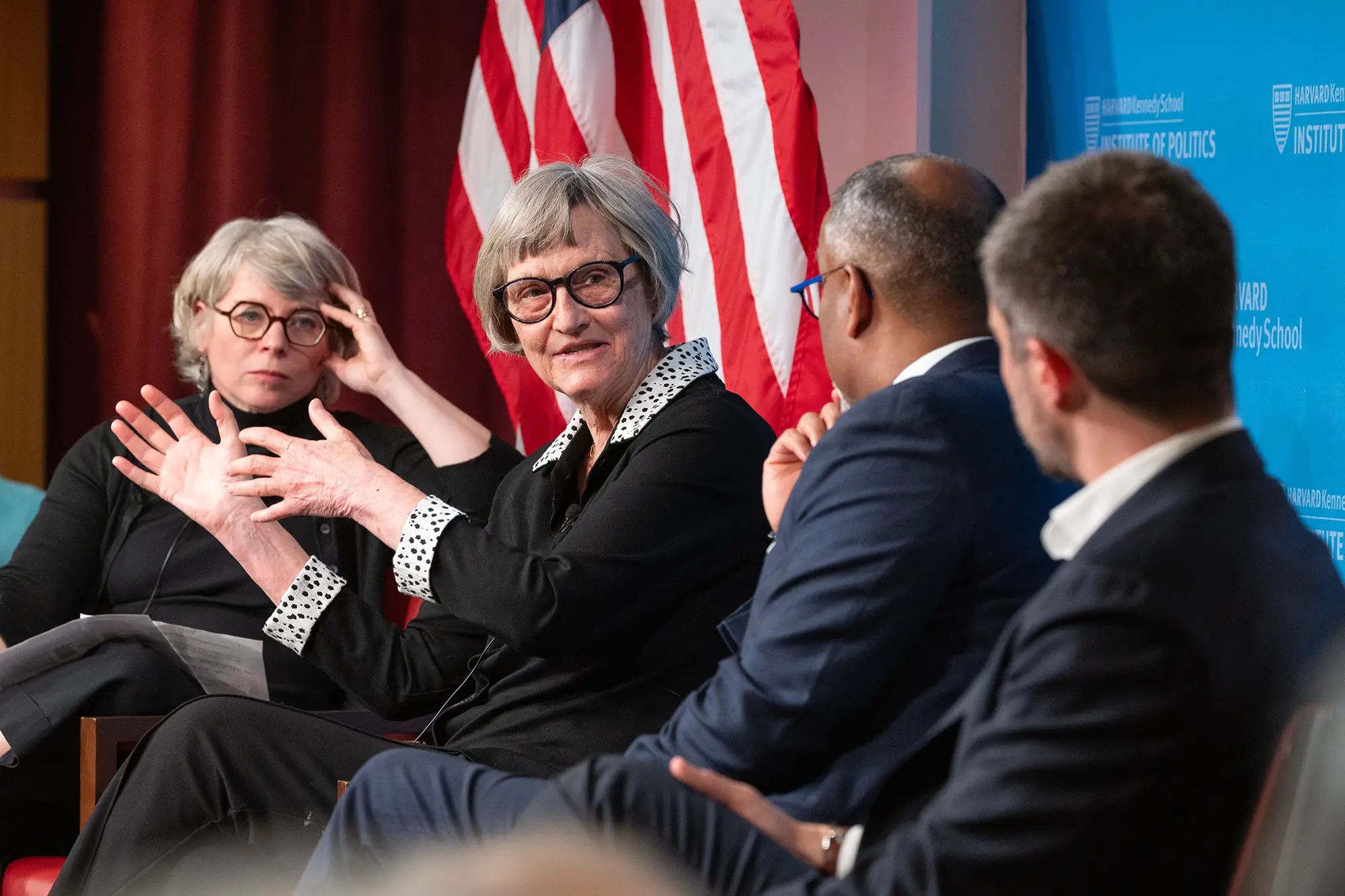
The Monday evening event was the first in a series of discussions at HKS this semester marking the 250th anniversary of the nation’s founding. (Upcoming speakers include former U.S. Senator and Republican presidential nominee Mitt Romney, M.B.A. ’74, J.D. ’75, and environmentalist and author Bill McKibben ’82.) Loosely focused on the theme of unity and disunity, the panelists spoke about polarization—past and present—the notion of belonging, and the future of the American political system.
“We’re actually in one of those rare moments, which, for all of the pain and the pathology of being an American right now, could also be an incredibly fertile moment for different patterns, different coalitions, and perhaps a very different electoral map in the near future,” said Buttigieg, a current IOP visiting fellow, who first rose to political stardom as the young mayor of South Bend, Ind., an office he held from 2012-2020. After running for president in 2020, he joined President Joe Biden’s cabinet.
An undercurrent throughout the conversation at the IOP was uncertainty about the future. The first question during the Q&A session came from a former career U.S. Foreign Service officer who was laid off in 2025, one of 300,000 federal employees forced out or into early retirements by the Trump administration last year. Now a student at HKS, she asked Buttigieg about how to protect and rebuild public service careers.
Buttigieg responded by saying that the current political moment carries both opportunity and danger. “We’re in the middle of this festival of destruction to our institutions,” he said, “but that could lead to an incredibly creative period.”
Recent polling has suggested that an electoral backlash is building against President Donald Trump and the Republican Party in this year’s midterm elections, but Buttigieg cautioned that if Democrats do prevail in future elections, they must reimagine government and institutions, not simply try to turn back the clock. “If there's one thing I’m preaching right now,” he said, “it’s that our job as a country and the job of my political party is not to somehow take power, find all the bits and pieces of everything they smashed … tape it all back together, and serve it up to the world as it looked in 2022. That’s not going to work.”
On a panel with three historians—Lepore studies the U.S. Constitution, Faust the Civil War, and Glaude the history of race and racism—Buttigieg, as a politician, was the sunniest voice. “My experience has been,” he said, that the nation’s divided past “doesn’t have to be destiny, especially at a moment … like this, which is so unstable that a different American political coalition might be built.” He spoke about the need to broaden Americans’ sense of belonging to each other. The U.S. military encourages that kind of belonging, said Buttigieg, who served in Afghanistan as a naval reserve officer. And so do universities, he argued. “That’s part of why the university is such an important invention,” he said. “It creates an opportunity to scramble some of those other circles of belonging, with intergenerational encounters, geographic encounters, ideological diversity, and many other forms of diversity.” Faust agreed, pointing to the way Harvard’s randomized undergraduate housing lottery throws together students from different backgrounds.
But when Buttigieg expressed optimism over the fact that the United States had overcome profound divisions and bitter fragmentations in past eras, Lepore, who is serving as moderator for the entire HKS discussion series, reminded him about the large-scale political violence that took place during the run-up to the Civil War in the 1850s and the civil rights movement of the 1960s. “I seldom take comfort in the fact that things have been bad before,” she said. “Is it necessary to go through the throes of that violence for change to happen?”
In fact, Lepore had started off the discussion by showing a series of maps that illustrated just how deep and durable the country’s divisions have been. A blue-and-red electoral map from 1888, highlighting the geographic distribution of votes in that year’s presidential election, lined up almost exactly with the demarcations in an 1850 map of the country’s free and slave states. It also lined up with a map of the 2020 election.
Faust noted another close alignment: recent maps produced by Ackman professor of economics Raj Chetty, who researches the geography of poverty and upward mobility in the United States. “To see these inequities of a slave society replicated in the work of a contemporary economist at Harvard is very chilling,” she said.
Glaude, though, cautioned against reading too much into the maps, which “oftentimes [lead] us to overburden the South with the sins of the nation,” he said. “The maps, on a certain level, actually feed the myth that the moral problem resides there, as opposed to in the heart of the nation.”
He recited a catalog of conditions that existed in the United States during previous big celebrations of the nation’s founding: 1876, the dawn of Jim Crow; 1926, “the decade of the Klan”; 1976, riots in Boston over school desegregation through busing. And in the current moment, he said, “What we’ve witnessed over the last 50-plus years is an evisceration of any robust notion of the public good. We’ve become self-interested persons in pursuit of our own aims and ends in competition and rivalry with each other.”
What would it mean for us to imagine ourselves differently?” he continued. “That’s not going to come from politicians…. It’s going to come from us, understanding our role.”
Faust made a similar argument, through the lens of the Civil War Union dead. “Having read so many letters of people who were going to go to war and sacrifice their lives,” she said, “I just was so moved to think that they did it for a notion of a nation and a union. … People were willing to die for that, and I just think we owe them something.”