The Harvard men’s hockey team has named Rob Rassey as the next head coach after a two-month search, following the departure of longtime head coach Ted Donato ’91.
Rassey left his post as associate head coach of the University of Michigan’s team to come to Cambridge. But it’s not his first run with the Crimson—Rassey served as an assistant coach with Harvard’s men’s team from 2013 to 2019. In his previous stint, he helped Harvard earn four NCAA Tournament appearances, two ECAC Championship titles, and the team’s first Beanpot Championship win in more than 20 years.
After leaving Harvard, he spent two years as a scout for the National Hockey League (NHL) and a year as a junior hockey coach, before moving to Michigan. He served as the University of Michigan’s assistant coach for just one season before assuming the associate head coach role in 2022.
Nichols Family Director of Athletics Erin McDermott praised Rassey as a “true teacher” who focuses on both the team and his players individually.
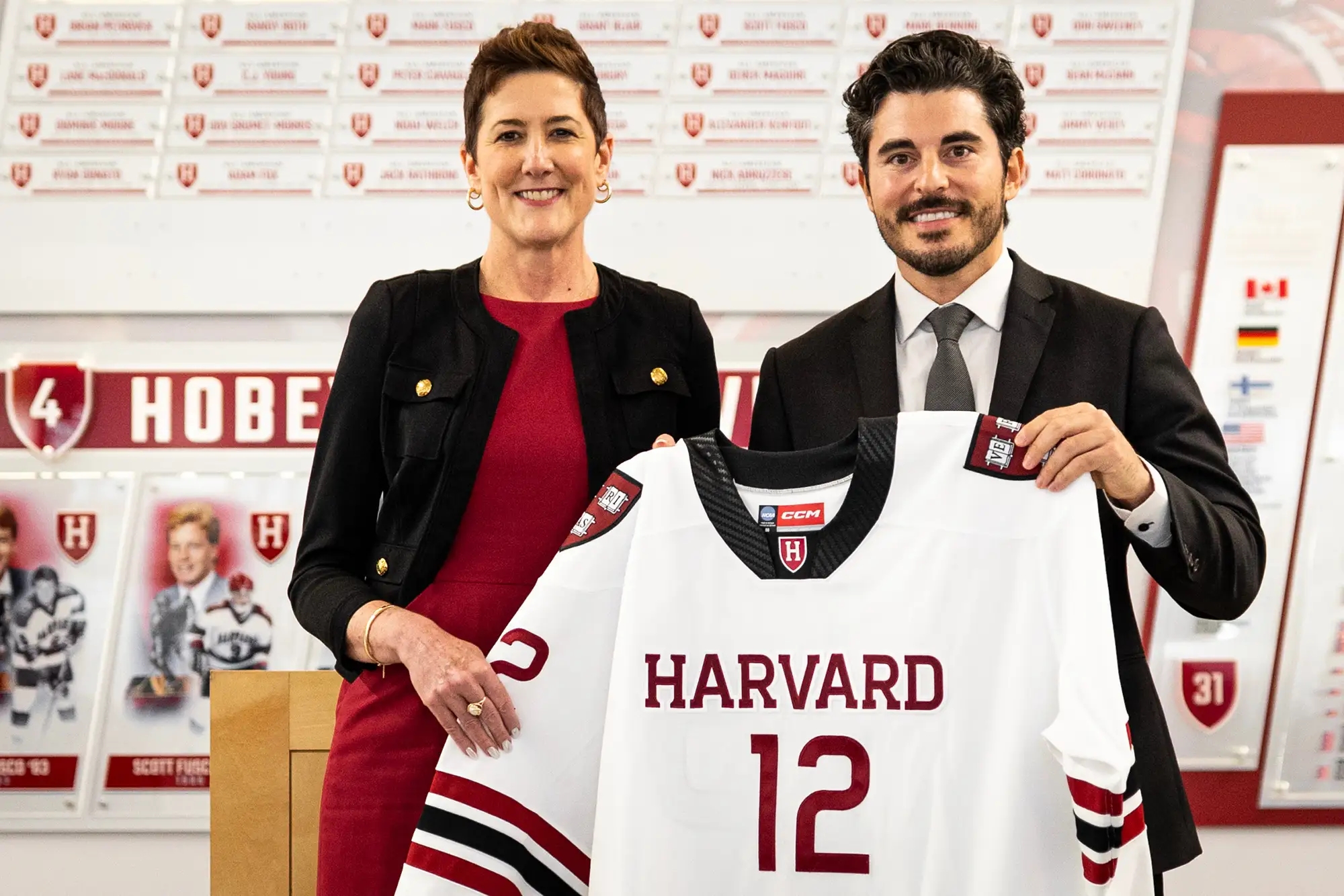
“He coaches because he believes that developing young men is his calling, developing them as players and developing them as people,” McDermott said at a Thursday press conference, “with trust as the foundation of an unselfish culture with high standards.”
In his previous role at Harvard, Rassey helped coach a host of future NHL players—including Alex Kerfoot ’17 and John Marino ’20 of the Utah Mammoth, Adam Fox ’21 of the New York Rangers, and Jimmy Vesey ’16 of the Nashville Predators.
Echoing McDermott’s praise of his player-first philosophy, Rassey said at the press conference, “Our goal as a staff will be to help each player maximize their potential as hockey players and as people, and one of those is not more important than the other.” There is no place better than Harvard, he said, for developing students in the classroom, adding, “Our goal will be to replicate that on the ice.”
Rassey said that returning to Harvard and giving players the opportunity to play Division I hockey while attending a top-ranked university was a “no-brainer.”
At the helm, Rassey will be faced with leading the team through major changes in college sports, including expanded athlete compensation, increased use of the transfer portal, and evolving recruiting rules. Following the NCAA’s landmark antitrust settlement in June 2025, schools can now directly share revenue with athletes, while expanded name, image, and likeness (NIL) opportunities and the transfer portal have reshaped recruiting and roster management, allowing players greater freedom to transfer and earn compensation.
The new rules have intensified competition for players, as schools with larger athletic budgets can now offer direct revenue-sharing payments alongside NIL opportunities. The transfer portal has also made roster turnover more common, forcing coaches to recruit both high school prospects and experienced college players. Still, Rassey said the fundamentals of building his team are unchanged.
“We’re still looking for the same types of people. We’re looking for hockey players [who] want to challenge themselves at the highest level, [who] want to try and win a national championship at Harvard, and hopefully go on to a career in the NHL,” Rassey said. “We’re looking for people [who] want to challenge themselves to be the best in the world in the classroom as well, so what we’re looking for in people is, for me, the exact same.”
But Rassey said what happens off the ice will matter most. He pointed to education and building a team culture outside of the arena as essential parts of the program under his leadership.
“We’ll make sure that we get our guys spending time together doing things together as a team,” Rassey later said in an interview. “My firm belief is that the closest teams usually end up winning.”