


Hunting a Hardy Hemlock
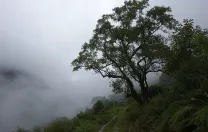
Toward the end of the first day of the 2017 NACPEC expedition to Sichuan, the collectors saw evergreens from across a reservoir that they thought might be Chinese hemlock (Tsuga chinensis). Until the 1980s, specimens of this tree growing in the West could all be traced to a single E.H. Wilson introduction. In the 1990s, the species demonstrated resistance to an adelgid that had begun wiping out hemlocks (Tsuga canadensis) along the east coast of North America (see “A Hemlock Farewell,” July-August 2014, page 8), making it a priority to acquire more of the Chinese variety.
Upon closer inspection, although there were three or four hemlocks, just one had cones, and only on a single branch that grew beyond a slope ending in a precipice that dropped 50 feet to the river below. The next thing I knew, I was up the tree with a handsaw—7,500 miles from home and hours from the nearest hospital—swept up in the thrill of the hunt. When half cut, the heavy branch swung slowly down within Andrew Gapinski’s reach, but just as the green fronds began to settle gently into the side of the slope, the limb snapped. For a few precarious seconds, the freed butt balanced, perfectly vertical, with the heavy cut end up. And then it wavered, teetering toward the river. “NO, NO, NO, NO, NO,” yelled Gapinski. The heavy butt, if it somersaulted, would pull the limb into the river—and all the cones with it.
And then somehow, as if defying physics, the butt slowly eased back past vertical toward the tree. Below, Gapinski grabbed a branch and yelled, “Got it.”
The next time I was gripped by tree-climbing fever, when the stakes were much higher, collecting seed from a rare beech (see main text), we took no chances—the limb was roped in.