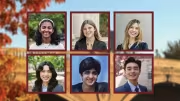
Mathematician Lauren K. Williams was one of three Harvard-connected scholars to be named MacArthur Fellows this week. The Robinson professor of mathematics, Williams specializes in “elucidating unexpected connections between algebraic combinatorics and concepts in other areas of math and physics,” the MacArthur Foundation’s announcement said.
Commonly nicknamed “genius” grants, the MacArthur fellowships are awarded across disciplines and are intended to both recognize major accomplishments and facilitate future ones. “At the heart of the MacArthur Fellows Program is its aim to identify extraordinarily creative individuals with a track record of excellence in a field of scholarship or area of practice, who demonstrate the ability to impact society in significant and beneficial ways through their pioneering work or the rigor of their contributions,” says the foundation’s website. The selection committee especially prizes innovators of “exceptional creativity,” whose promising work could be enabled by the foundation’s support. Each fellow—22 in total this year—receives a no-strings-attached award of $800,000, paid out in five yearly installments.
Combinatorics, Williams’s specialty, refers to a branch of mathematics that focuses on counting, sorting, and arranging discrete objects and it is often considered one of the toughest disciplines in the field. Williams has made major contributions in several areas of mathematics, while also tackling long-standing problems in physics related to quantum field theory, particle physics, and wave propagation. Many of her breakthroughs involve what’s called the “positive Grassmanian,” a shape whose points represent components of simpler geometric objects.
A 2000 graduate of the College, Williams earned a Ph.D. at MIT and returned to the University as a postdoctoral fellow, before later joining the faculty. In 2018, she became only the second woman to be tenured at Harvard in mathematics.
Political scientist Hahrie Han ’97 studies “critical questions about how and why people participate in civic and political life,” the MacArthur Foundation said in its announcement of her fellowship. “Employing a range of ethnographic, sociological, experimental, and quantitative methods, she examines organizational structures and tactics that encourage individuals to interact across lines of difference and work together for change in the public sphere.”
A professor at Johns Hopkins University, Han is the director of the SNF Agora Institute, an organization that tries to strengthen civic engagement and “inclusive dialogue.” She is also the faculty director of Johns Hopkins’s P3 Lab, a multidisciplinary research lab within the institute that looks for ways to make individuals’ participation in public life “possible, probable, and powerful.”
Han’s research investigates what motivates people to become politically active—and the barriers that prevent them from doing so. Her book How Organizations Develop Activists: Civic Associations and Leadership in the 21st Century (2014) used observational fieldwork, surveys, and experiments to look at civic organizations’ strategies for mobilizing activists and building power in the internet age. For a more recent book, Undivided: The Quest for Racial Solidarity in an American Church (2024), Han spent years studying an evangelical megachurch in Cincinnati, Ohio, that had launched a faith-based racial justice program. She sought to learn what had pushed the mostly white parishioners to take part, eventually supporting a tax hike to pay for early childhood education for poor, and mostly Black, communities.
Astrophysicist Kareem El-Badry, previously a junior fellow in the Harvard Society of Fellows and a postdoctoral fellow at the Harvard-Smithsonian Center for Astrophysics, examines binary star systems, black holes, and other stellar bodies, using astronomical datasets and theoretical modeling. More than half of the universe’s stars are not single, like the sun, but binary, meaning they orbit another star—but often, these celestial bodies are too close together to be differentiated with available technology. El-Badry, a professor at the California Institute of Technology since 2023, developed a method for identifying binaries, using data from the APOGEE (Apache Point Observatory Galactic Evolution Experiment) project and later the Gaia mission and so far, he has discovered millions of these binaries.
In other work, El-Badry has developed a way to identify dormant black holes, including the closest one to Earth. (When they are not close enough to another stellar body to interact with it and steal its matter, black holes are impossible to detect using conventional methods). El-Badry has also shown that certain stellar bodies that were once thought to be dormant black holes were in fact stars that had been stripped of their outer layer and were contracting.