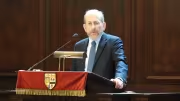
The University announced today that David M. Rubenstein, co-founder and co-CEO of The Carlyle Group, the private-equity and investment-management firm, will join the Harvard Corporation in July 2017. Although Rubenstein is an alumnus of Duke (where he chairs the board of trustees, with a term ending next year) and the University of Chicago Law School (where he is a university trustee), he has been especially active as a leading philanthropist during The Harvard Campaign. His daughters, Alexandra Nicole Rubenstein ’07 and Gabrielle W. Rubenstein ’10, both graduated from the College, and his wife, Alice Rogoff Rubenstein, earned her M.B.A. from Harvard Business School in 1978.
Although the announcement a year in advance is unusual, the appointment is in effect a slow-motion double-switch, to use a baseball metaphor. Last December, Princeton president emerita Shirley Tilghman was elected to the Corporation, filling the vacancy created by the death of James F. Rothenberg, a leading investment-management executive, the prior summer. Now, Rubenstein, an investment professional, is in the queue to fill the planned departure, at the end of the next academic year, of Nannerl O. Keohane, president emerita of Wellesley College and Duke.
In a joint statement accompanying the news announcement, President Drew Faust and Corporation Senior Fellow William F. Lee hailed Rubenstein’s “acumen in finance, his experience both in leading a complex organization and in serving as an institutional trustee, his capacious intellect and global outlook, his devotion to universities and to the arts and culture, and his capacity to inspire generosity in others.” They noted, “We are fortunate to be able to welcome—in Shirley Tilghman and, before long, in David Rubenstein—two such accomplished and collegial leaders to help guide the University forward.” In a note e-mailed to the community, Faust and Lee wrote, "We will have time to celebrate Nan’s invaluable contributions to Harvard over the course of the coming academic year."
The announcement quoted Rubenstein as saying, “Harvard is a truly unique global institution of higher learning and cutting-edge research, and I am humbled to be associated with such an institution in this way. I hope John Harvard would approve.”
At Harvard, Rubenstein has:
- served as a co-chair of the current overall University campaign;
- served as interlocutor with Bill Gates ’77, LL.D. ’07, during a conversation on philanthropy (to which the two billionaires have different approaches) at the campaign kickoff events in September 2013; and
- served as chair of the Harvard Kennedy School campaign—to which he donated $15 million for fellowships in two separate gifts in 2004 and 2008, and where his fundraising prowess (and perhaps own philanthropy) have enabled the school to be at 98 percent of its $500-million goal by last report (in February), and to proceed at full speed on its massive campus renovation.
He is also a member of the dean’s advisory council at the business school, a member of the Kennedy School visiting committee, and chair of the Global Advisory Council, created to support Harvard’s international activities (read the description here).
As a philanthropist, Rubenstein has helped expand the National Archives, repair the Washington Monument, restore Monticello, support Mount Vernon, enlarge the Kennedy Center for the Performing Arts, and endow Duke’s rare book and manuscript library (which bears his name), among many other significant benefactions. (In Cambridge, his enthusiasm for historical documents is on display in President Faust’s office.) He serves on numerous nonprofit institutions’ boards of directors and trustees
Unusually among private-equity managers, Rubenstein is outspoken on certain public issues, perhaps reflecting his prior experience in private law practice and in government. A recent New Yorker-ProPublica “Letter from Washington,” focusing on the favorable tax treatment of private-equity and hedge-fund managers’ “carried interest,” reported on Rubenstein’s leadership role for his industry in defending that tax provision. In that outspokenness, at least, he will be a different sort of Corporation member than Rothenberg, who kept his counsel close to the vest, at Harvard and Caltech, where he was also a trustee.
Read the Harvard announcement here.