Harvard scientists announced today that they have developed a robotic device made from soft, biomimetic materials that could one day restore the ability to pump blood in patients with heart failure. The invention, demonstrated in Yorkshire pigs, represents a pioneering use of soft robotics internally, although a great deal of further development, miniaturization, and testing will be needed before it could be used in humans.
Previously, soft robots that interact with people have been used primarily for “exoskeletal,” external support devices. Worn like clothing, such devices can enhance the physical capabilities of healthy individuals in walking or gripping objects (see “Wearable Robots”) or support the motions of people with motor impairments. The robotic heart sleeve, designed instead to be implanted, is “really significant,” says former Harvard doctoral student Ellen T. Roche, first author of the Science Translational Medicine paper that describes the research. “More and more people are surviving heart attacks and ending up with heart failure,” she says. “Soft robotic devices are ideally suited to interact with soft tissue and give assistance that can help with augmentation of function, and potentially even healing and recovery.” (Below, see an echographic video of the device assisting a failing heart.)
In pigs with drug-induced heart failure that reduced cardiac output to about 45 percent of baseline, the device restored cardiac output to an average of about 97 percent of the pre-failure levels. A potential advantage of the robotic sleeve over existing implantable pumps—known as ventricular assist devices, or VADs—is that it does not involve contact with circulating blood, and therefore does not require the long-term use of blood thinners (which can increase the risk of stroke) that VADs do.
About 2.8 million Americans with heart failure suffer from a condition in which the heart does not fully contract, and therefore pumps less blood. Of these, more than 140,000 experience symptoms of heart failure even at rest, and are therefore candidates for the 2,100 heart transplants that take place annually. The new robot, the researchers say, could be used to bridge the time before a donor heart becomes available, or as an assistive device during rehabilitation of the heart.
Developed in a collaboration between the School of Engineering and Applied Sciences (SEAS), the Wyss Institute for Biologically Inspired Engineering, and Boston Children’s Hospital, the device is made of silicone that contracts when pressurized with air and expands when a vacuum is applied. It is designed to slide over the heart like a sleeve. Like the outermost layers of the human heart, which consists of two layers of heart muscle that contract in different directions, the device swells and shrinks both circumferentially and helically. One set of actuators, distributed like rings on a barrel, expand and contract concentrically. A second set of actuators, in a separate layer of silicone, expand and contract helically, twisting in a motion that could be compared to the wringing and unwringing of a towel. Working together, these two types of contractions and expansions are what pump blood in the mammalian heart. The device effectively mimics these natural motions, and is tunable, so that it can provide support for diastolic or systolic motions, in a customizable manner.
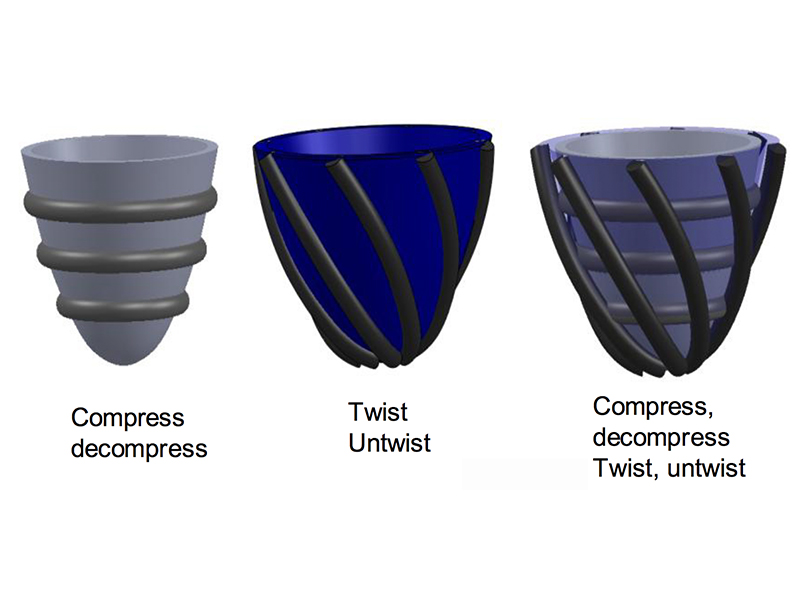
The device combines concentric rings with helical structures to mimic the orientation of the outer two layers of cardiac muscle in mammalian hearts.
Courtesy of Ellen Roche
“This work represents an exciting proof of concept result for this soft robot, demonstrating that it can safely interact with soft tissue and lead to improvements in cardiac function,” said senior author Conor Walsh, Loeb associate professor of engineering and applied sciences at SEAS and a core faculty member at the Wyss Institute. “We envision many other future applications where such devices can deliver mechanotherapy, both inside and outside of the body.”