The architectural views above are displayed in the fourth-floor bedroom corridor at the Harvard Club of New York City. They have been there since 1915, and for at least 80 years they were unidentified. Members and guests have scratched their heads and wondered where this exotic building might be. Its architect was Louis Christian Mullgardt, officially a member of the class of 1893, although he took courses only briefly at Harvard. Later a prominent California architect and a nonresident member of the Harvard Club of New York, he donated and inscribed these four photographs to the memory of his class, but unfortunately did so illegibly, leading to an undetermined title and unknown provenance in the club’s inventories.
Mary Saunders, the club’s curator, says that recently “the astute scrutiny of a sculptor determined that these are not real buildings at all.” A subsequent Internet search revealed that the photographs are of Mullgardt’s Tower, part of the Court of Abundance, a temporary construction made of plaster, burlap, and lath for the 1915 Panama-Pacific International Exposition in San Francisco.
Saunders cares for a collection of more than 2,000 items comprising about 100 painted portraits of Harvard men and women and some 50 mounted taxidermy specimens, along with photographs, posters, certificates, prints, and drawings, all relating to members’ association with the University and donated to the club over the years. She has been on the job (albeit not full time) for nearly 29 years and is always delighted when some mystery of the collection is solved.
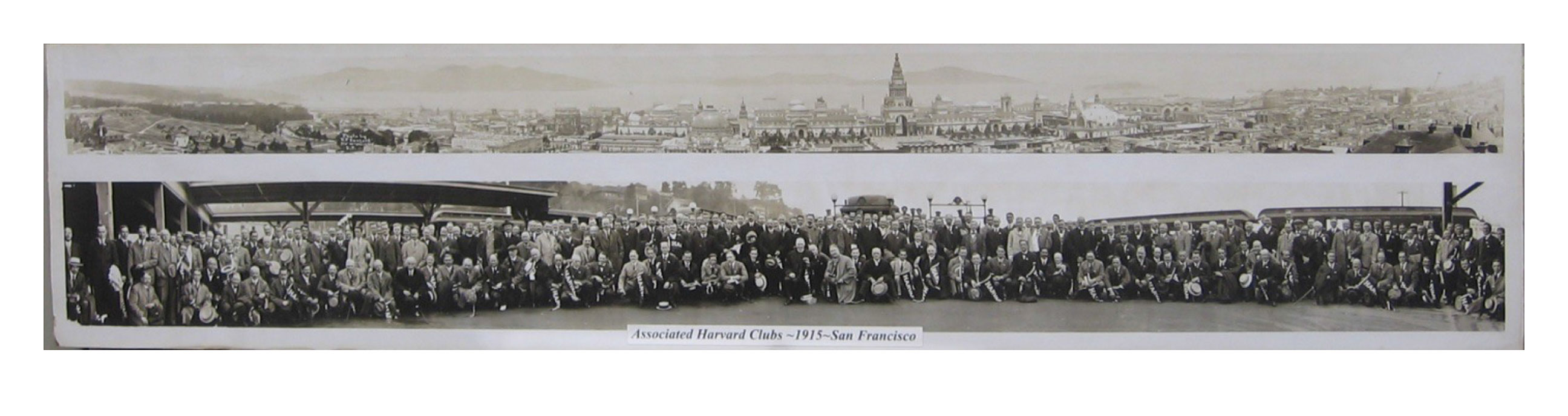
To see the completed Mullgardt’s Tower, a panoramic photograph of the Exposition, and another of a mass of jolly alumni who traveled to San Franciso to take in the Exposition and attend the annual meeting of the Associated Harvard Clubs, visit the accompanying photo gallery. Some went on a deluxe exclusive train from Chicago, and some shipped out together, July 31 through August 22, on the steamship Finland through the newly opened Panama Canal. See them splashing happily in the ship’s pool.

So much for a Harvard degree. Richard Field Maynard, A.B. 1898, transferred to Harvard “after two miserable years at Cornell University,” reports his daughter Sylvia Maynard ’44, an artist who lives in Cambridge. She has a diary her father kept when he was here as an undergraduate. His problem was that he really wanted to be in art school. After he escaped these confines, he went to Manhattan, studied painting at the Art Students League, and painted until he was into his seventies. Here’s what he told his diary on Saturday, January 8, 1898: “If I could get out of college honorably, I believe it would not take me long to pack. I want to draw, but because I must get a degree, I have not the time. A degree is worthless in itself and does not signify what it pretends to. It is of value only because by receiving it the disgrace of not receiving it is avoided.”