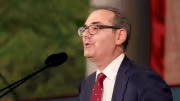
Though Guinness World Records doesn’t track this category, Richard Peña ’75 might be a movie-viewing champion. In a normal year, he will watch 2,700 films, an average of nearly seven per day. True, many aren’t feature-length, and Peña doesn’t watch every one all the way through, but even so, he has a fair claim as the nation’s leading movie buff. “I never get tired of watching movies,” he says. “And I do watch Hollywood films.”
That last assertion is relevant because, as program director of the Film Society of Lincoln Center (filmlinc.com), Peña takes in works from all over the world in a kaleidoscopic variety of formats, genres, styles, and languages. About 2,000 of his annual screenings are submissions to the New York Film Festival (NYFF), the annual 17-day movie orgy at Lincoln Center. Along with a selection committee, Peña winnows these candidates down to 100 serious contenders. Then, during two grueling weeks in August, they choose an average of 28 features and 12 short films for the prestigious festival (this year’s runs from September 25 to October 11), which can launch a filmmaker’s career. The Spanish director Pedro Almodóvar, Ar.D. ’09, for example, gained international recognition with his Women on the Verge of a Nervous Breakdown, which premiered at the NYFF in 1988.
The Film Society, which publishes Film Comment magazine, produces the NYFF; the festival was founded in 1963 in the belief that “the greatest works of film art are absolutely on a par with the greatest achievements in all other artistic media,” says Peña. It began in the ferment of two seminal movements: the auteur theory, and filmmaking’s inquiry into movies and modernism. “The film as a director’s personal expression was a paramount notion,” he says, “as was the breaking of convention, finding new forms and new ways of telling stories.”
“We show very few films and we shine a very bright spotlight on them,” Peña says. “We have been the showcase where the vast majority of important filmmakers and film movements have been introduced to American viewers”: including the Czech and Hungarian cinemas of the 1960s, Rainer Fassbinder and the New German cinema movement of the 1970s, “almost every important African filmmaker,” and directors like Bernardo Bertolucci (Last Tango in Paris, in 1972), Martin Scorsese, (Mean Streets, in 1973), and Michael Moore (Roger and Me, in 1989). There’ve been controversies, too: a papal comment triggered round-the-clock pickets of Jean-Luc Godard’s Hail Mary (1985), and the Chinese government asked the festival, in vain, to remove a 1995 documentary on Tiananmen Square. (The society co-produces events like the Human Rights Watch International Film Festival.) The society also stages special festivals, with ethnic, regional, or religious themes, for example, that include outreach to schools; classes often attend screenings.
“I was always somebody who went to a lot more movies than anybody else,” Peña says. He grew up in East Harlem and then Queens, the son of a Puerto Rican father and Spanish mother. At Harvard he specialized in Latin American history and literature. “There were very, very few Harvard courses then that focused on film at all,” he recalls. After a year of traveling in Latin America, he eventually wrote his honors thesis on Brazilian and Argentine cinema. He taught film studies at Harvard and Berkeley and then directed the Art Institute of Chicago’s Film Center from 1981 until 1988, when he returned to New York to chair the NYFF’s selection committee and become the Film Society’s program director. He also teaches film theory and international cinema as a professor of film studies at Columbia University.
“Film has always been globalized,” he says. “The problem now is the tremendous growth of the multinational industry of Hollywood: the space for progressive film has gotten smaller, and the role for foreign-language films in the United States is shrinking.” Peña believes that, compared with the innovative decades of the 1960s and 1970s, “Audiences today are much more conservative, much less willing to be challenged. That sense of going to the movies as an adventure is being lost. I remember how [the 1961 Alain Resnais film] Last Year at Marienbad challenged me, as a young man, to understand it. Today, younger audiences in general want to know what they’re getting—that’s why we have this spate of remakes of older films and television shows, and several versions of Batman and Spiderman.”
Part of the mission of the NYFF is to counteract this trend toward dumbing down cinema. Peña likes making his job as an exhibit curator dovetail with a scholarly approach. A few years ago, for example, he co-curated a series on German cinema from 1945 to 1960: “After the War, Before the Wall.” This formerly overlooked era soon became the subject of several books. “Many people credit us with having made an intervention that changed how people think of that time before Fassbinder,” Peña says. “There were some considerable talents, and some very popular cinema. I like my job, especially when I feel that I’m helping to write film history.”