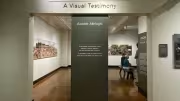
A Harvard Business School exhibition on early trade with China

An exhibition from Harvard Business School's historical library collections documents the first wave of U.S. trade with imperial China.

Tea production in China, c.1790-1800
Augustine Heard, of Ipswich, Massachusetts, built on his experience as a brig captain to found his own trading firm to do business in China.
A receipt for textiles (from the Heard Family business records)
The merchant Hoqua, portrayed by George Chinnery, c.1830, amassed a $26-million fortune, placing him among the world’s richest men.
Silk samples, c.1850
The Heard Company flag
The company&rsquo;s 700-ton steamship the <i>Fire Dart</i>, commissioned in 1859-1860 for the Yangtze River trade after the Second Opium War. It flies the Heard colors.
Aymon. "Les quatres fils" [The Four Heard Brothers.]
Pedder Street Clock Tower and Hongkong Hotel, Central District. Victoria Harbour.
Belcher, Edward. Canton and its approaches, Macao and Hong Kong. Map. London: George Cox, Jan. 1st 1853

[extra:Extra] 

Images from the exhibit, beyond those that appeared in print, appear in the gallery at top. 

The earliest United States trade with China, it may be hard to remember, began just after independence from Great Britain. It initially involved such goods as tea and textiles, and amounted to tens of thousands of dollars, rather than trillions. The addictive good of the era, shamefully, was opium (a major component of Chinese imports), rather than the torrent of Apple consumer gadgets flowing outward today. Unlike the great European joint-stock enterprises—the Dutch East India Company and its British counterpart—the American traders were New England entrepreneurs who set up private firms or merchant syndicates.

A Chronicle of the China Trade, an elegant exhibit at Baker Library drawing on Harvard Business School’s historical collections (through November 17, and online at www.library.hbs.edu/hc/heard), documents this commerce through the remarkable records of Augustine Heard & Co., from 1840 through 1877 (just one of the library’s collections of such materials). The documentary evidence, complemented by American artifacts and materials on loan from Hong Kong and Shanghai, details the growth of the family business and the swelling volume of cotton, silk, porcelain, and other goods crossing the ocean. It explores rapid institutional change, from the Chinese system of limiting trading to licensed hong monopolies under imperial control, to the forced opening of so-called treaty ports (after the Opium Wars) and the rise of compradors who managed business as trading-house employees. It follows the spread of business from coastal enclaves into China’s interior (a pattern repeated during the past three decades); the physical and social evolution of trade communities; the deployment of game-changing, speedy new technologies (clippers and steamships, antecedents to the modern cargo jet, and the telegraph); and the lubricating effects of new banking services, credit instruments—even (tea) crop futures. And yes, fortunes were made (and lost)—not only by the Heard enterprise but also by Chinese traders who proved utterly adept at business.


You might also like

Creepy Crawlies and Sticky Murder Weapons at Harvard

In the shadows of Singapore’s forests, an ancient predator lies in wait—the velvet worm.

Concerts and Carols at the Isabella Stewart Gardner Museum

Tuning into one of Boston's best chamber music halls 

The Artist Edward Gorey—and Pets—at Harvard

Winter exhibits at Houghton Library   

Most popular

Harvard Faculty Discuss Tenure Denials

New data show a shift in when, in the process, rejections occur

Harvard’s Class of 2029 Reflects Shifts in Racial Makeup After Affirmative Action Ends

International students continue to enroll amid political uncertainty; mandatory SATs lead to a drop in applications.

What Trump Means for John Roberts’s Legacy

Executive power is on the docket at the Supreme Court.

Explore More From Current Issue

A woman (Julia Child) struggles to carry a tall stack of books while approaching a building.

Highlights from Harvard’s Past

The rise of Cambridge cyclists, a lettuce boycott, and Julia Child’s cookbooks

Wadsworth House with green shutters and red brick chimneys, surrounded by trees and other buildings.

Wadsworth House Nears 300

The building is a microcosm of Harvard’s history—and the history of the United States.

A man in a gray suit sits confidently in a vintage armchair, holding a glass.

The Life of a Harvard Spy

Richard Skeffington Welch’s illustrious—and clandestine—career in the CIA