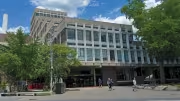
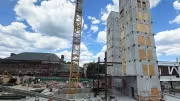
The Boston Redevelopment Authority (BRA) voted unanimously on Thursday night to allow the University to move ahead with its Institutional Master Plan (IMP)—nine projects totaling 1.4 million square feet for Harvard’s expanding campus across the Charles River in Allston. The approval establishes overall zoning guidelines, but each project will have to undergo further individual review, and comes as Harvard is about to commence site preparation for a previously approved Science Center on Western Avenue, said University officials.
The nine projects include: an addition to Harvard Stadium that will add indoor seating and office space; a new, larger, basketball gymnasium; a 150- to 250-room hotel/conference center located on Western Avenue across from Harvard Business School (HBS); and various renovations and additions to HBS’s campus, such as a new auditorium for Burden Hall, faculty and administrative offices, and renovation of the adjacent Soldiers Field Park housing complex. The IMP also sketches Harvard’s long-term vision for its Allston campus, which—while in no way binding—would in future decades transform the area from paved, vehicular-oriented, industrial and commercial uses to others similar to those of Harvard Square and its environs, with walkable green spaces, numerous transit options, retail districts centered on road intersections, and permeable, shady quadrangles with many substantial academic buildings.
President Drew Faust sent a letter to the Allston community on Friday morning calling the projects “diverse” and “complementary,” and explaining that “the retail offerings envisioned in the Gateway building will support the new residents in Barry’s Corner, and the faculty, students, and staff in the Science building; the hotel and conference center will be an important complement to the new Executive Education buildings at the Business School and to the growing presence of engineering and applied science on Western Avenue.”
Faust added that the $6.5-billion Harvard Campaign, launched this fall, will provide “momentum” for further development in Allston, specifically involving the School of Engineering and Applied Sciences (SEAS), which will be moving to facilities on Western Avenue. The move “will enhance collaborations across disciplines and Schools and encourage connections among the University, the community, and new partners in industry and research,” Faust stated in her letter. “I truly believe that no institution of higher education has a more exciting opportunity for innovative growth, in an intellectual and entrepreneurial environment as dynamic as we have in Boston and Cambridge.”
Members of the Harvard-Allston task force, as well as representatives from the mayor’s office, the offices of state legislators, and various labor unions spoke in support of the IMP. “We all put an enormous amount of work into understanding this complicated plan and we rose to the challenge of intelligently responding and seeing it through,” task-force member Tim McHale wrote in an e-mail to the Allston community after the hearing. “I am proud of this work and very grateful to you that we put all this time, energy, and faith into this effort. We are the stewards of our neighborhood and we showed our commitment to the Community and to each other through this process.”