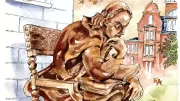
At certain moments, creative sparks fly. How this came to pass at one such moment is the subject of The Fellowship: The Literary Lives of the Inklings: J.R.R. Tolkien, C.S. Lewis, Owen Barfield, Charles Williams (Farrar, Straus and Giroux, $30), by Philip Zaleski and Carol Zaleski, Ph.D. ’84, professor of world religions at Smith College. Their massive portrait enfolds the Christian writer (Lewis), mythmaker and Old English scholar (Tolkien), historian of language (Barfield), and publisher and supernaturalist (Williams), among others. From the prologue:
During the hectic middle decades of the twentieth century…a small circle of intellectuals gathered on a weekly basis in and around Oxford University to drink, smoke, quip, cavil, read aloud their works in progress, and endure or enjoy with as much grace as they could muster the sometimes blistering critiques that followed. This erudite club included writers and painters, philologists and physicians, historians and theologians, soldiers and actors. They called themselves, with typical self-effacing humor, the Inklings.
Novelist John Wain, a member of the group who achieved notoriety in midcentury as one of England’s “angry young men,” remembers the Inklings as “a circle of instigators, almost of incendiaries, meeting to urge one another on in the task of redirecting the whole current of contemporary art and life.” Yet the name Inklings, as J.R.R. Tolkien recalled it, was little more than a “pleasantly ingenious pun…suggesting people with vague or half-formed intimations and ideas plus those who dabble in ink.” The donnish dreaminess thus hinted at tells us something important about this curious band: its members saw themselves as no more than a loose association of rumpled intellectuals, and this modest self-image is a large part of their charm. But history would record…that their ideas did not remain half-formed nor their inkblots mere dabblings. Their polyvalent talents…won out. By the time the last Inkling passed away on the eve of the twenty-first century, the group had altered…the course of imaginative literature (fantasy, allegory, mythopoetic tales), Christian theology and philosophy, comparative mythology, and the scholarly study of the Beowulf author, of Dante, Spenser, Milton, courtly love, fairy tale, and epic; and drawing as much from their scholarship as from their experience of a catastrophic century, they had fashioned a new narrative of hope amid the ruins of war, industrialization, cultural disintegration, skepticism, and anomie.…They were…lovers of logos (the ordering power of words) and mythos (the regenerative power of story), with a nostalgia for things medieval and archaic and a distrust of technological innovation that never decayed into the merely antiquarian. Out of the texts they studied and the tales they read, they forged new ways to convey old themes—sin and salvation, despair and hope, friendship and loss, fate and free will….