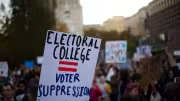
Why do Americans elect our presidents as we do: spending billions of dollars on campaign hoopla and social-media flame wars, and then turning the whole shebang over to the bewiggery of an Electoral College? Stirling professor of history and social policy Alexander Keyssar, a Kennedy School expert on voting, among other subjects (see “Voter Suppression Returns,” July-August 2012, page 28), has delivered Why Do We Still Have the Electoral College? (Harvard, $35)—a timely, nuanced account of this strange institution, its embeddedness in U.S. politics, and the implications for today. From the introduction:
The institution that Americans now call the “Electoral College” has been a source of discontent for more than 200 years.…
For many citizens of the twenty-first century, the problematic features of the Electoral College are not far to seek. Most obviously, the institution makes it possible for the winner of the popular vote to lose the electoral count and not become president—an outcome that violates conventional expectations about the workings of electoral democracy. This has happened five times in our history, most recently in 2016, and it has come close to happening on numerous other occasions, including 2004. A related issue is that the Electoral College does not conform to the widely accepted principle of “one person, one vote.” Because electoral votes are allocated to each state based on the size of its congressional delegation in the Senate and the House combined, the votes of residents of small states carry more weight, per capita, than do the votes of large-state residents. In 2016, for example, Wyoming cast one electoral vote for every 190,000 residents; in California, an electoral vote represented 680,000 people.
Equally troublesome is the practice, in every state but Maine and Nebraska, of awarding all of a state’s electoral votes to the winner of its popular vote. This long-standing, but not constitutionally mandated, feature of presidential elections leaves millions of voters feeling that their votes do not really count, especially if they live in states where one political party is dominant. It also has a profound impact on election campaigns, which are now conducted almost entirely in “swing” or “battleground” states, while those that are less competitive are largely ignored except for fund-raising. The use of “winner-take-all” in the states also contributes to the possibility that someone other than the winner of the national popular vote could become president.
It is largely for these reasons that a majority of Americans since the 1940s—when modern, scientific polls on the subject were first conducted—have consistently expressed a preference for changing the presidential election system.