Under the pre-existing zoning, Harvard had the right to build up to 120 feet high, though "from the outset, Harvard realized that it would never build to those heights," says Mary Power, the University's senior director of community relations. Harvard's original development proposal for the Memorial Drive site was for two low, glass- and wood-clad buildings housing a museum of modern art. A vocal group of local residents vowed to stop that project and demanded instead that the land be turned into a park. They petitioned to have the area downzoned.
The University countered by offering instead to build housingthe predominant use there today (Mahoney's notwithstanding). Residents at first rejected this option outright as well, but eventually a deal was struck that was attractive to both parties, although it will cost Harvard at least $15 million, according to the rough estimate of one city official. Under the terms, building heights will be capped at 65 feet along Memorial Drive, at 55 feet on Cowperthwaite Street, and at 35 feet on Grant and Banks Streets. Harvard also agreed to give the corner of the Mahoney's site bordering Memorial Drive and Western Avenue to the city for a park, and to build at least 30 units of affordable housing in a former industrial building that is part of the Harvard-owned Blackstone power plant on the street corner opposite.
For itself, Harvard plans to build affiliate housing, mostly configured as small units for graduate students. Said chief University planner Kathy Spiegelman, "Some of the buildings will be at the scale of the three-deckers and the small buildings that are in those neighborhoods now; these will have larger units that might be for graduate students, but might also be appropriate for faculty." The University expects to accommodate 250 beds at each of the two sites, where it will replace existing parking with underground facilities.
Two teams of architects will prepare designs for Harvard: Bruner/Cott and Chan Krieger & Associates at the river site, and Elkus/Manfredi Architects at the Cowperthwaite and Grant Streets site.
Harvard has no redevelopment plan for the power plant proper, so the new zoning agreement acknowledges the existing power generation as an allowed use; this will let the University make improvements without going through extensive permitting processes. "But if we want to build new buildings or if we want to move existing uses out of the existing buildings," notes Spiegelman, "there would be a public, special-permit process."
Spiegelman attributes the success of the negotiation in part to the way it was structured: as a combination of base zoningdesigned to be unattractive to both partiesand incentives. The base zoning allows buildings too large for the neighbors to be comfortable with, and too small to be efficient for the University, while the incentives (affordable housing, the public park) were tailored to the wishes of the neighborhood and accompany increased capacity for University housing at both sites. Harvard originally proposed that the park be situated farther into the Mahoney's site, so that a building would shield it from the busy intersection of Memorial Drive and Western Avenue. But for many residents and some city councilors, says Spiegelman, "the public visibility of having [the park] on that corner overrode" other concerns about noise and the increased difficulty of building the underground parking.
The park and the affordable housing will be turned over to the city only after all of Harvard's occupancy and other permits have been issued. The University expects to move quickly on the design phase and will bring its plans to the Cambridge planning board for review as soon as possible.

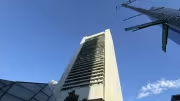
 Harvard has reached an agreement with residents of the Riverside neighborhood and the City of Cambridge that will allow the University to construct housing for affiliates between Cowperthwaite and Grant Streets (above) and along Memorial Drive.
 Harvard will donate land for a public park at Memorial Drive and Western Avenue, on the corner now occupied by the Mahoney’s Garden Center (below, left), and also construct 30 units of affordable housing in a former switch house it owns (at right), once part of the Blackstone power plant (below, right).