 |
| Hongkun Park |
| Photograph by Stu Rosner |
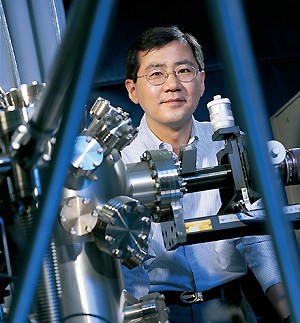
"Your brain doesn't run at three gigahertz, believe me," kids professor of chemistry and of physics Hongkun Park. But even though the brain is not as fast as a computer, it is much better at having a conversation or recognizing a face. "That's because it has different operating principles," Park says. Scientists have studied individual neurons and, using MRI, have studied whole brains, but the intermediate step -- how connectivity among tens of thousands of neurons relates to function -- is poorly understood. Park, who is one of the first scientists to make a transistor from a single molecule (a switch so small that it wiggles and bounces when a single electron passes through), has started a project to electrically interrogate every single neuron in a slice of functioning brain simultaneously, in real time, to monitor how chemical imbalances propagate between neurons. Eventually, he hopes to understand the dynamics of the brain's neural network. Park was born in Korea into a family of many doctors. "They could make a general hospital," he says. He came to this country after college and mandatory military service, earning a Ph.D. from Stanford in 1996. After postdoctoral work at Lawrence-Livermore National Laboratory, he arrived at Harvard in 1999. Park, whom at least one colleague calls "the best condensed-matter physicist at Harvard," teaches freshmen their chemistry and his young daughter her do-re-mi's. "Playing with your child," he says, "is probably the most joyous thing you can do."