When Harvard was founded, most of its students arrived rich in practical experience, and in need of some abstraction: colonists knew how to plow, how to build, how to work the physical world. Higher education was for adding a layer of mediation: some Latin, some classics, some theology.
Today, 375 years later, students arrive fully mediated: they’ve spent endless hours in front of a screen and, chances are, very few in contact with the natural world. They can’t, most of them, do very much that isn’t abstract. They’ve changed, 180 degrees, and so that which higher education provides should change as well. If college is about supplying what’s missing, then it’s time to dig up a good chunk of the Yard and plant a garden.
Does that seem absurd? Haven’t we gone well beyond the moment when graduates of the world’s most prestigious university need to know how to do something with their hands? Maybe, but maybe not. On a planet that’s headed into a very stormy future (literally—thanks to a warmer climate, scientists are now observing some of the most extreme weather ever recorded), we can no longer blithely dismiss farming as an easy task someone else will always take care of. (Calories per capita are no longer increasing on this planet.) The same applies to providing the energy we need, and performing all the other physical tasks that for a couple of centuries have seemed less important to those at the top of the heap. We may need to actually do something real again—not just for our security, but for our over-abstracted souls.
Indeed, the U.S. Department of Agriculture reported last year that the number of farms in America is increasing for the first time in 150 years, and increasingly it is well-educated young people who are doing the growing. I know recent Harvard graduates who are running exemplary small farms—and making more high-stakes decisions in a day than their classmates who took the obvious route to Goldman Sachs.
So I hope that by 2036 the College is teaching classes in agriculture, and helping us to understand that it’s a culture as important, and classy, as all the other cultures studied within the gates. Over-mediated young people, even if they’re not going to grow their own food, or install their own solar panels, need a field trip away from the abstract. The polish higher education should be adding now looks more like grit.
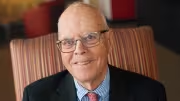
Bill McKibben ’82 is Schumann Distinguished Scholar at Middlebury College and founder this year of the global climate campaign 350.org (https://350.org). He was elected to the American Academy of Arts and Sciences in April.