It’s a dizzying time for philosophy. The rise of AI and the tech revolution, global threats to democracy and growing populist extremism, climate change, inequality, wars, a pandemic—amid all this, the search for wisdom feels more urgent than ever.
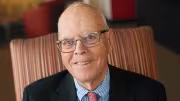
Enter political philosopher Michael Sandel. The Bass professor of government—who won the prestigious 2025 Berggruen Prize for Philosophy and Culture—is best known at Harvard for his iconic undergraduate course, “Justice” (where the moral debate over maritime cannibalism is one of many topics considered). As a public thinker, Sandel draws stadium-sized audiences and writes popular books on pressing subjects like meritocracy, justice, and democracy. Much of his work levels sharp critiques at how globalism reshaped American society, contributing to increased inequality and creating an “impoverished” idea of freedom.
In October, Sandel spoke with Harvard Magazine about these issues. Highlights from that conversation are excerpted below.
On civic life as a marketplace:
In recent decades, we have tended to conceive of freedom in excessively narrow, individualistic, consumerist terms, as if freedom consists only in being able to satisfy one’s preferences in the marketplace. We have drifted from having a market economy to becoming a market society—a place where everything is up for sale and market values reach into every sphere of life. This consumerist idea of freedom is too narrow to sustain the project of self-government. It creates a sense of disempowerment that is one of the deepest sources of discontent with democracy. The only way to address it is to recover the civic understanding of freedom as sharing in self-rule, deliberating about public affairs, and arguing and reasoning together, especially across our differences.
On the dark side of meritocracy:
The tendency of credentialed elites to look down on those without degrees, what I call the tyranny of merit, created a divide between winners and losers.
This divide arises from inequalities of dignity, respect, social recognition, and esteem. Those who landed on top came to believe that their success was their own doing, the measure of their merit, and, by implication, that those left behind must deserve their fate, too. This harsh way of thinking about success…is what generates the politics of grievance and humiliation that fuels the rise of right-wing authoritarian populists who promise retribution against elites.
On how the pandemic upended civic life:
First, it isolated us. Second, it deepened the distrust of experts. Public officials charged with making hard choices about, for example, whether to close schools would often say, “I’m just following the science.” It was a way of evading responsibility for what are ultimately political judgments. And political judgments must be informed by public health and medical advice, but science by itself can’t tell us how to live together and contend with crisis. For that, we need well-informed public deliberation.
The suspicion of experts was already pervasive, thanks to the failed advice of mainstream economists during the years of neoliberal globalization and the failure to regulate the financial industry, which led to the financial crisis of 2008 and the taxpayer bailout of Wall Street.
This fueled the suspicion of experts [during] the pandemic. And my worry is that unless we can enable citizens to have a more meaningful voice in public decisions, we’re going to have the same problem with climate change and the transition to the green economy, where we also find a tendency to invoke experts and technocratic solutions without engaging in deliberation at the local level.
On our broken public discourse…:
We need to engage more directly with big questions that citizens care about, including questions of values. In recent decades, we have tended to shrink from addressing contested ethical questions in public discourse for fear of disagreement. And it’s true, we live in a pluralist society where people disagree on fundamental questions, on moral issues. There is a tendency to assume that the way to a tolerant society is to avoid engaging with these questions—to ask citizens to leave their moral and spiritual convictions outside when they enter the public square.
Instead, genuine pluralism requires engagement. People want politics to be about big things. I think that when public discourse feels hollowed out of larger meaning, sooner or later, it will be filled by narrow, intolerant moralisms of two kinds: fundamentalism and hyper-nationalism. And this is what we see today, not only in the United States, but around the world.
…and on how to fix it:
In part, we need to create more class-mixing institutions, common spaces that gather people from different walks of life. I’m not talking just about classrooms or public forums or televised debates. I’m talking about parks and recreation areas: playgrounds, municipal swimming pools, sports stadiums. One of the most corrosive effects of recent decades is that…economic inequalities have been translated into social and civic inequalities. This isn’t good for democracy. Democracy does not require perfect equality in the sense of everyone having the same income and wealth, but it does require that citizens from different backgrounds bump up against one another in the course of their everyday lives, because this is how we learn to abide our differences. This is how we come to care for the common good.