Harvard, nearing its four-hundredth anniversary, is encrusted with traditions—never more so than during its Commencement rituals. The entry for “Academic regalia of Harvard University” in the undergraduates’ new best friend (Wikipedia) begins with this wisdom (including a charming Britishism):
As the oldest college in the United States, Harvard University has a long tradition of academic dress. Harvard gown facings bear crow’s-feet emblems near the yoke, a symbol unique to Harvard, made from flat braid in colours distinctive of the wearer's qualification or degree. Crow’s-feet are double for earned degrees, and triple for honorary degrees.
A word to those undergraduate paper-writers: the passage, we are proud to note, properly cites Cynthia Rossano’s 1999 article for this magazine, “Reading the Regalia: A guide to deciphering the academic dress code.” She observed there that the origin of the unique crow’s-foot device
is described in a letter written by [Samuel Eliot] Morison in 1936. Professor Eugene Wambaugh, as a member of [President Charles William] Eliot’s committee on academic dress, had been asked to see that the proposed gowns be given some distinctive Harvard feature. Morison writes: “The committee decided that all Harvard hoods should be lined with crimson; and Dr. Wambaugh, who had been reading up Harvard history, had heard of crow’s-feet adopted for undergraduates’ dress in 1822.”
“One Cambridge gentleman,” continues Morison, “produced a jacket worn by his grandfather, and an old grad sketched the crow’s-feet from memory. Both agreed, and double crow’s-feet in different colors, to represent the different faculties, were recommended in the committee report for the lapels of Harvard gowns. The report was at first ‘laid on the table’ by the Corporation, President Eliot being much against caps and gowns, but was finally adopted in 1902.”
Of the various colors chosen to mark the different degrees, some derive from the Middle Ages and have easily remembered historic connotations. White for the bachelors of arts and sciences comes from the white of the Oxford and Cambridge B.A. hoods; dark blue for the doctor of philosophy is the color of truth and wisdom; medium gray has long represented business; lilac, dental medicine; and yellow, design. The scarlet for divinity follows the traditional color of the Christian church and crucifixion; light blue for education is again the color of truth and wisdom, as is the peacock blue for government. Purple for law is reminiscent of bygone kings who made the laws; salmon pink signifies public health; and the green for medicine is the green of medicinal herbs.
On careful review, the passage of time, and Harvard's evolution, have rendered Rossano’s catalog of “rainbow-hued crow’s-feet” slightly incomplete, and lacking in an essential detail. Both, in the detail-oriented hands of Stephan Magro, the new Commencement director, have been remedied for this 366th edition of Harvard’s graduation exercise.
The New Kids on the Block
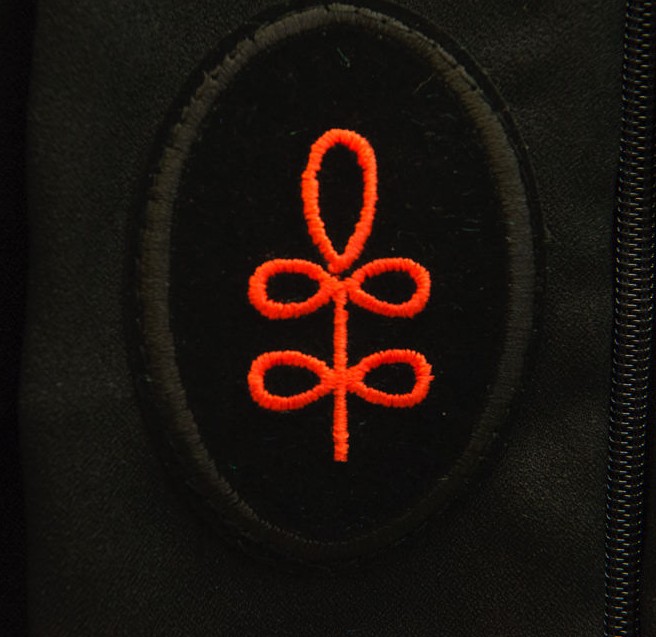
The new "orange/gold" crow’s-foot for the School of Engineering and Applied Sciences—Harvard's youngest school, now in its tenth year
Photograph by Jim Harrison
Effective September 20, 2007, at the outset of Drew Faust’s presidency, the division of engineering and applied sciences was elevated to a school of engineering and applied sciences (SEAS), within the Faculty of Arts and Sciences. Now, approaching its tenth anniversary, this newest, cuttingest-edge Harvard school is being dipped in tradition: SEAS is getting its own, distinctive crow’s-foot color. On Thursday, candidates for master’s degrees will proudly sport what Magro describes as an “orange/gold” device: the orange nods to the customary color for engineering, the gold for science, as he explains the logic.
The bureaucratic reasoning is impeccable: dental medicine (celebrating its sesquicentennial) gets its own color (lilac), even though it formally nests within the Medical School (the aforesaid green).
There is, inevitably, one further complication: joint bachelor’s/master’s students will still wear white crow’s feet, because a student must technically be awarded the bachelor’s degree before a master’s. Or so Harvard tradition dictates.
Honor(ands) Served
From deep in Harvard’s past, the official language decrees that “Holders of honorary degrees…are entitled to wear a triple crow’s foot of the color appropriate to the faculty represented by the degree.”
But for reasons now lost to memory, the tradition has been breached, apparently since the early 1980s—a distressingly casual era when honorands wore no regalia (Julia Child) or their suitable costume (General Colin Powell, in uniform), or their own academic gowns. Magro also suggests that Cotrell & Leonard, established in 1832 and considered the “originator of the cap and gown industry in America,” underwent business difficulties that resulted in a change in Harvard’s source of supply.
Whatever the reason, Harvard continued to confer honorary degrees but, by its own standards, inadvertently short-changed the recipients, whose gowns have for the past three decades or so been issued sans crow’s feet. Now, proper order has been restored, just in time to recognize Mark Zuckerberg (who ironically did not wait around to collect his College degree with its white design) and his fellow honorands in 2017.
A Final Note
For obsessives who wish to delve much deeper (the text runs 18 dense pages, with 113 footnotes and a two-page bibliography), Nicholas A. Hoffman’s “Crow’s Feet and Crimson: Academic Dress at Harvard,” from Transactions of the Burgon Society, is available online—just like Wikipedia.