Last night, University officials presented the proposed first steps toward developing its “enterprise research campus” (ERC)—a non-academic “innovation” district for established companies and startups, as well as a hotel and conference center, together with residential space—to a crowd of Allston residents at the Harvard Innovation Lab. The proposal, expected to be formally filed next week, is part of a regulatory submission that must be reviewed by Boston development authorities.
The proposal outlines how a commercial entity might develop part of a 14-acre parcel of land (currently empty)—itself a part of the much larger, 36-acre ERC plot controlled by the University in Allston, not far from the Charles River and south of Western Avenue, across from Harvard Business School (HBS). The site is also near the new science and engineering complex, which is scheduled to accommodate much of the engineering and applied sciences faculty by 2020.
The ERC plan anticipates 900,000 square feet of developed space just south of Western Avenue: 400,000 square feet of office and lab space; 250,000 square feet of residential space; a 250,000-square-foot hotel and conference center, already described and approved in an Institutional Master Plan (IMP) for Harvard’s Allston campus; and—on much of the rest of the site, large surface parking lots for 800 to 900 vehicles. These proportions are not binding, University officials said, and may change significantly in later stages of planning. The parking lots are meant to accommodate commuters, but only on an interim basis, said Harvard’s senior Allston planner, Harris Band; eventually, those sites will become available for development under the University’s long-term framework for the district.
The concept for the district emerged in a 2011 report by Harvard’s Allston Work Team, which imagined that it would “‘open a gateway to a collaborative community for business, investment capital, research and science development’—in other words, a commercial facility similar to Research Triangle Park situated between three universities in North Carolina.” The idea is to draw on the energy of HBS and Harvard’s applied scientists and engineers, and to extend connections to the Longwood medical area and other local universities. But, Band stressed, “The vision is not just of a program, but of a place….We’re not just creating an office park here. We’re trying to create a real place...guided on the basis of sound planning principles that promote community,” so that it will “involve an active mix of uses” and have “resilient, sustainable infrastructure, accessed by walking, transit, and biking…and robust public grounds.” Although Harvard owns the land, it apparently does not plan to develop the area itself; it has not yet announced development partners for the site. (The Continuum complex, at the intersection of North Harvard Street and Western Avenue, was built by Samuels & Company, which leases the site from Harvard.)
Although the formal proposal has not yet been filed with Boston authorities, Allston residents expressed a range of objections during the community meeting: the perceived vagueness of the plan, concerns about congestion and access to transportation along neighborhood streets, and the mix of the kinds of spaces and development planned for the plot. The 2013 IMP, for example, had rendered the district with significantly more green space than the new plan:
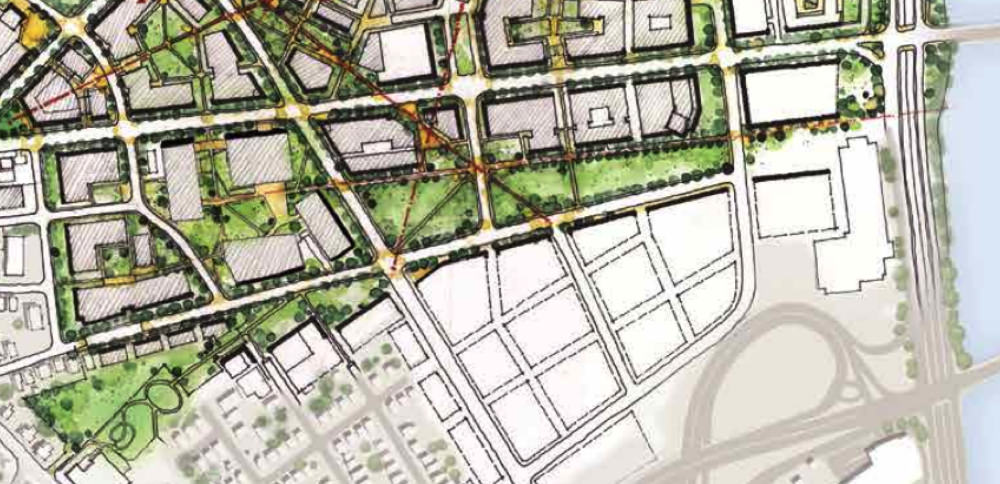
An older rendering of the enterprise research campus, from the 2013 Institutional Master Plan
Allston resident Harry Mattison, a member of the Impact Advisory Group that will advise Boston regulatory authorities on the University’s plan, said on the day after the community meeting that “Harvard’s presentation last night left a lot of unanswered questions, and created a lot of questions about how the transportation in Allston is going to work, to both deal with the crushing numbers of cars we have today, plus the tens of thousands of people that Harvard envisions living and working in the neighborhood. There’s a strong hope that Harvard would honor the vision that it had just a few years ago to create a major greenway that connects to the Charles River, but what Harvard showed last night was much thinner.”
The University plans to file the Planned Development Area Master Plan with the city next week. That will trigger a 45-day comment period before the proposal can be considered for zoning approval. As of this writing, University officials had not indicated whether feedback from residents at last night’s meeting would result in any changes to the substance or timing of Harvard’s filing.
Meanwhile, next week, the Massachusetts Department of Transportation will meet to announce the next phase of planning for the realignment of the Massachusetts Turnpike in Allston, which courses between the residential district there and the Charles River. Harvard’s planned construction feeds directly into the Turnpike’s Allston/Brighton interchange, raising questions about how transportation infrastructure will support the millions of square feet of development envisioned for this part of the city.