In the spring of 2020, Emilee Hackney ’20 was sitting with an old friend in the parking lot of a Dollar General in her hometown of Tazewell, in the Appalachian Mountains of southwest Virginia. They had met a few years earlier while working at Subway but lost touch after Hackney left for Harvard. When she saw him walking along the road, she picked him up and pulled into the lot so they could catch up. “We’re looking at each other and talking to each other,” she says, “and we’re like, ‘What are we doing here? What are we going to do with our lives?’”
Hackney had been living with her parents in Tazewell since Harvard had shut down its campus in March because of the COVID-19 pandemic. In college, she’d often felt homesick and missed her family. But home felt different after being at Harvard. Her internet cut out five to six times an hour, making remote classes—let alone remote work—nearly impossible. Life back in Cambridge seemed increasingly distant, she says: “I had moments where I was like, ‘Did that even really happen?’”
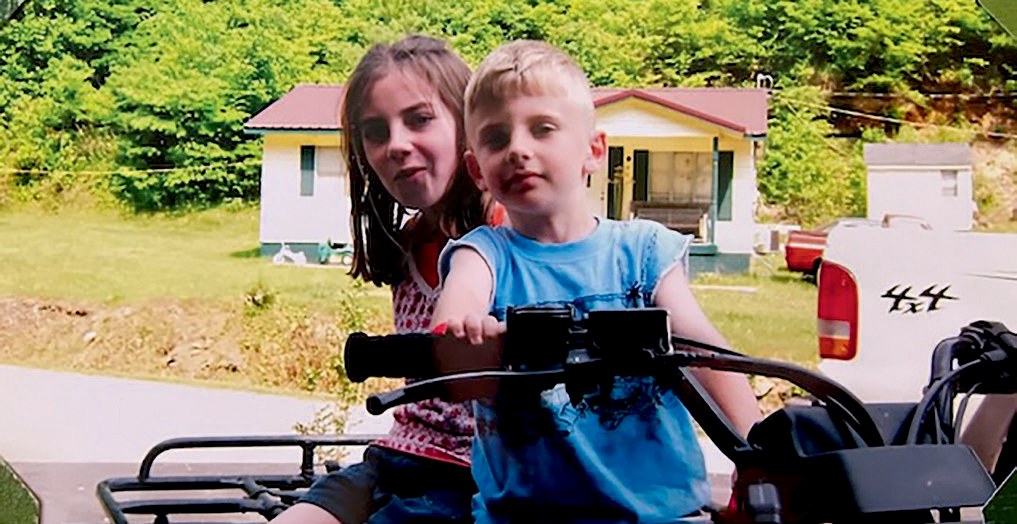
Still, she’d been lucky compared to her friend who had never left. He was an intelligent, sensitive, sweet-natured person who had also been to jail, struggled with addiction, and survived an overdose. He was “one of those people who could do anything, if he’d been able to get out of Tazewell,” Hackney says. “I think about all the people [who] could achieve so much had they been in my position.”
In Tazewell, Hackney was also working on her senior thesis, a series of essays about growing up in Appalachia and going to Harvard. Her advisor, the bestselling author and then-professor of the practice of nonfiction Michael Pollan, helped Hackney get a literary agent, and those essays eventually became a book, All That’s Unseen: An Appalachian Memoir, to be released on July 28. In it, Hackney explores what it means to be an eighth-generation Appalachian, with an extended family that has lived, worked, and died within 50 miles of each other. Tazewell, she writes, is “a dying little coal town, deeply isolated even by Appalachian standards,” and “my favorite place on earth.” She bristles at stereotypical depictions of Appalachians as “some kind of backward hillbillies who, you know, drink moonshine and play the banjo.” Yet she also delves into some cultural realities—the poverty and addiction, the enduring impact of the coal mining industry, and the sometimes-doctrinaire social structure—and recounts her emerging need for a radical personal change.
Comparisons between Hackney’s book and U.S. Vice President J.D. Vance’s 2016 bestselling memoir, Hillbilly Elegy, seem inevitable. Like some other critics of Vance’s book, Hackney takes issue with Vance’s use of his own success story as evidence that hard work alone can overcome hardship, ignoring the more systemic economic and political issues that have affected Appalachia. Vance’s bootstrap narrative, she says, assumes that “people know how to escape systems that have been in place for generations. Not a lot of people in my family, in my school, knew what opportunities were out there.”
Fortunately for Hackney, a few did. Her mother, who grew up with a raging alcoholic father, never drank—and married a man who didn’t, either. She earned a college degree, became a teacher, and created a family, Hackney says, “that was much more stable than the one she grew up with.” Hackney’s father became a West Virginia State Police officer and was later an administrator in a coal mine. Together, Hackney says, “they never really wanted to settle for the status quo.”
Still, Hackney had no plans to leave Tazewell; she intended to marry her boyfriend, a fellow member of her Pentecostal church whom she began dating when she was 14 and he was 18. The church promoted the idea of men as leaders and women as followers; some congregants even believed that women should obey their husbands. Hackney, at the time, believed this was God’s will; in her book, she describes submitting to being spanked by her boyfriend for “sinful” thoughts or feelings as part of a “domestic discipline” practice.
Then in 2016, when Hackney was a year out of high school and enrolled at a community college, she received shocking news that suggested her fiancé was not who he appeared to be. Everything she had trusted as good seemed to vanish. Spurred by anger at her fiancé, who, she said, had undermined her educational endeavors, she applied as a transfer student to several Ivy League schools a few hours before the deadline. Harvard said yes.
When she arrived in Cambridge as a sophomore assigned to Cabot House, Hackney found the academic load difficult and realized she had never learned how to study. The northeastern social culture was foreign, and she opted out of joining religious groups on campus, upset that the church back home had made her feel “small” and afraid to speak up. The transition to Harvard “was just culture shock on steroids,” she says. “I never felt at home with anyone or anything there. Part of it was my fault; I didn’t try hard to integrate into any groups. I would walk the streets and explore, and spend a lot of time running along the Charles. It was very solitary.”
Hackney sank into depression and almost dropped out. Eventually, though, she got psychiatric help, made friends, found a supportive boyfriend, and pulled up her grades. Creative writing classes became a sanctuary, especially a workshop led by Pollan. “Writing was what I knew I wanted to do and what I was good at,” Hackney says, “and that helped me find direction.”
Her post-graduation plan had been to settle in Tazewell. “I wanted to go home, and I missed it so much,” she says. But after the start of the pandemic and her virtual 2020 Harvard graduation, she felt uneasy in her hometown. The dearth of substantive jobs and growth opportunities didn’t help. So, in the fall of 2021, she moved to Nashville to pursue a master of fine arts degree at Vanderbilt University. Then, in November, her father died suddenly, and she was brought back to Tazewell again.
The following spring, Hackney tried to return to Vanderbilt, but her grief made it too hard to concentrate, so she left the program. Instead, she decided to follow through on an idea she and her father once shared: to hike the Appalachian Trail together. Despite a lack of experience backpacking or camping, she set out in March of 2022 and soon found relief in the consuming experience: “I was so exhausted by the end of the day,” she says. “I just wanted to sleep. I had no mental energy left for anything.”
The journey also provided time to reconfigure what “home” meant. At first, her father’s death made her feel even more disconnected from Tazewell, but as she hiked, she began to realize that home wasn’t a static concept. Some events also broke open her understanding of what spirituality could encompass. “That oneness with nature was a different kind of relationship to religion that I had never conceived of before,” Hackney says.
At night she always heard owls—sometimes seemingly right outside her tent—even when fellow hikers didn’t. She remembers a day a few months before her father died: “We were sitting out on our front porch, and there was an owl in the forest across the road,” she says. “And it was hooting, and he was kind of hooting back at it, and he was talking to it.” On the trail, she began to feel like the owls were “kind of my dad, in a way.”
While hiking, Hackney met her future husband, Charles Lacy, who was from a town near Tazewell; in 2023, she moved with him to Charlottesville, Virginia. She worked as an administrative assistant at the University of Virginia while weaving her essays into a larger memoir. That writing process led to reflecting more deeply on Harvard memories—like when, during those dark and difficult early months, she found solace in a statue she stumbled upon on the Harvard Business School campus. Inés, by Jaume Plensa, is a 23-foot cast-iron head of a woman with her eyes closed. At night, Hackney spent time with the figure, whose features shifted depending on where she stood. “Something about that distortion really interested me,” she explains. The full picture of the woman was fluid; it was never wholly present, nor could it be.
It seems a fitting metaphor for the project of her memoir. “No matter where I was,” Hackney says, whether at home or Harvard, “I was kind of caught in this in-between.” When in one place, she longed to be in the other. As she writes: “It was a confusion I’d wrestle with over and over: reconciling a person’s sins with their enduring kindness; or the abuses of religion with its many comforts; or the strangeness and loneliness of Harvard with its transforming powers.” Contradictions, she has found, just endure. She loves Appalachia; she loves to be away from Appalachia.
This January, Hackney gave birth to a daughter, Della. So, she laughs, there’s not “a whole lot of writing going on at the moment.” But ideas and notes are percolating around stories of her Appalachian Trail hike. Or maybe, one day, she’ll write more about religion. Her world religions class at Harvard, she writes in the memoir, had offered the idea of a “universal quest for morality and, opposite of what I’d once believed, many paths to achieve it.”
As of right now, she has no plans to return to Tazewell through words or in person—“too many bad memories,” she says. The church she was part of is still influential, and she doesn’t want to see, or hear about, her ex-fiancé. “It’s still a town where everyone knows everyone and gossip gets passed around,” she says, “and I just want to keep my distance.” But she might return to Appalachia. She’s always been awed by the landscape, the mountains—“confining and comforting, ancient and noble…I feel as if I was born from them, as if my bones were formed from their dirt,” she writes.
The people there helped shape and encourage her, too. She thinks of the old friend she reconnected with while home during the pandemic, to whom she dedicates her book, calling him “Jeremy.” After she left her fiancé and her church, Jeremy was the first friend she made outside of that religious structure; he represented a different kind of devotion and freedom. In the book, when she tells him she got into Harvard, he’s happy for her, eager to see what happens next and how she’ll fare. “Hell yeah,” he tells her. “Get the hell out of here. Go do something big.”