Sassetta's Borgo San Sepolcro altarpiece, reconstructed

Sixty paintings once adorned the altarpiece of a Franciscan church in the small Tuscan town of Borgo San Sepolcro. View illustrations from the modern-day reconstruction.

Sassetta: The Borgo San Sepolcro Altarpiece, a new book edited by art historian and Villa I Tatti fellow Machtelt Israëls, details the reconstruction of a "lost" Italian Renaissance altarpiece. Below, view images from the recent virtual restoration. To read more, see the main article, "Masterpiece Pieces."
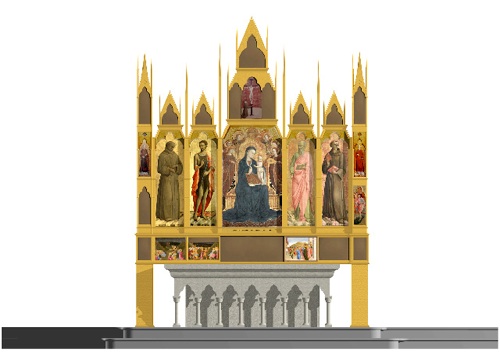
Reconstruction of Sassetta’s Borgo San Sepolcro altarpiece, front view.
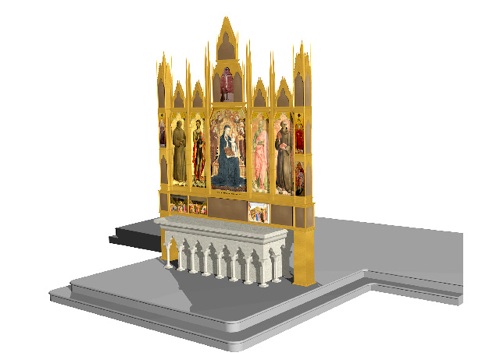
Reconstruction of Sassetta’s Borgo San Sepolcro altarpiece, oblique front view with its full piers, altar, and altar steps.
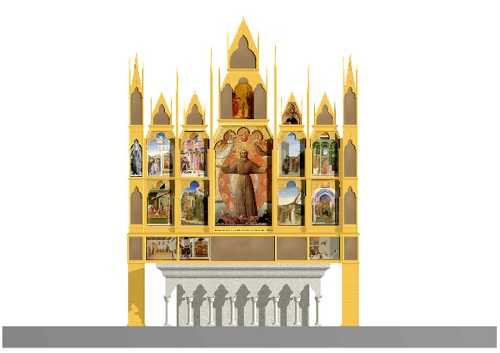
Reconstruction of Sassetta’s Borgo San Sepolcro altarpiece, back view.
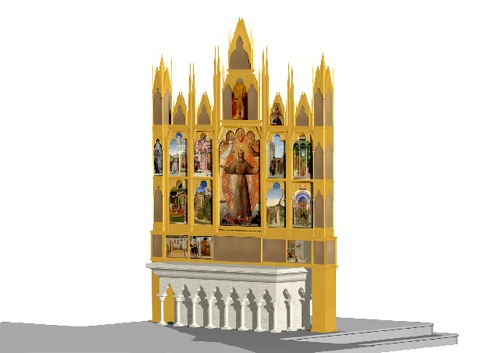
Reconstruction of Sassetta’s Borgo San Sepolcro altarpiece, oblique back view with its full piers, altar, and altar steps.


Credit for all images: Reconstruction by Machtelt Israëls, James R. Banker, Roberto Bellucci, Rachel Billinge, George Bisacca, Ciro Castelli, Cecilia Frosinini, Christa Gardner von Teuffel, Babette Hartwieg, Elisabeth Ravaud, Andrea Santacesaria, Carl Brandon Strehlke, Dominique Thiébaut, Serena Urry et al. Three-dimensional drawing by Andrea Santacesaria, Opificio delle Pietre Dure, Florence. Rendering by Giacomo Tenti, Culturanuova, Arezzo. © Villa I Tatti, The Harvard University Center for Italian Renaissance Studies.
Related topics

You might also like

Harvard Art Museums restores a rare glimpse of an American master.

Tk tk Iran

Artist Azadeh Akhlaghi reconstructs moments of Iranian political upheaval in a series of meticulously staged images.

Science and art capture the microscopic natural world.

Most popular

Harvard’s Class of 2029 Reflects Shifts in Racial Makeup After Affirmative Action Ends

International students continue to enroll amid political uncertainty; mandatory SATs lead to a drop in applications.

The University has pushed the adoption of AI into teaching and operations, but faculty resistance is growing louder.

In 1954, Gregory Corso moved into Eliot House. How he stayed there is a literary legend.

Explore More From Current Issue

A man in a suit speaks at a podium.

David Battat promotes alumni engagement.

Three actors perform on stage, with one actor interacting closely with another, set against abstract backgrounds.

The play Spare Parts is a contemporary fable about the quest to live forever.

A glowing bulb shape surrounded by colorful, swirling energy lines against a blue background.

Harvard researchers achieve medical breakthroughs in cancer therapy and infection control.