The Harvard Graduate Students Union-United Auto Workers (HGSU-UAW) announced this week that it would open a strike authorization vote on Monday, threatening to renew a 40-day walkout that ended in June without a contract. Union leaders spent the summer negotiating with the University, but in a statement released Thursday, HGSU-UAW president Evan Lemire, a doctoral candidate at the Harvard Chan School of Public Health, accused Harvard of “stonewalling tactics.”
The union represents more than 4,000 workers, including graduate research assistants and instructors, along with graduate and undergraduate teaching fellows and course assistants. The union’s previous contract expired in June 2025, and University officials and HGSU-UAW leaders have held 32 bargaining sessions. Union leaders were negotiating for higher compensation, a stronger grievance process for harassment and discrimination complaints, and more support for non-citizen workers, who have come under increased threat during the Trump administration.
The graduate student strike last spring was the longest in union history and upended teaching and grading during the final weeks of the school year. Picketing workers disrupted events during Commencement and pressured Boston Mayor Michelle Wu ’07, J.D. ’12, to withdraw as keynote speaker for the Harvard Law School Class Day. After Commencement, union leaders called off the strike, saying they were hopeful for renewed negotiations with the University but warning that a return to the picket line was possible this fall if a contract agreement could not be reached.
The strike authorization vote will close on October 6. If union members approve a walkout, they may be joined by the Harvard Academic Workers-United Auto Workers (HAW-UAW), whose members authorized a strike in July.
Certified in 2024, HAW-UAW represents more than 3,000 non-tenure-track faculty and other academic employees. The union is still bargaining for its first contract. Among its negotiating demands, according to the union’s website, is the removal of time caps that limit many teaching appointments to a maximum of eight years. Union leaders are also asking for expanded childcare and family benefits, and workload protections. HAW-UAW’s other demands—for higher compensation, non-citizen worker protections, and a stronger grievance process—are shared with HGSU-UAW.
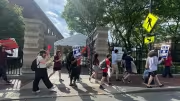
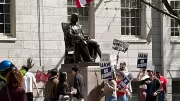
On Wednesday, roughly 400 members from the two unions rallied at both the Cambridge and Longwood campuses. “There is a real possibility of a joint strike, and joining our organizing forces to win fair contracts for all of us,” Lemire said in the statement.
Harvard also faces a potential action from its unionized dining hall workers, represented by UNITE Here Local 26, whose contract ended in June. Union members rallied outside of the Smith Center earlier in September, asking for better wages, healthcare benefits, and employment stability.