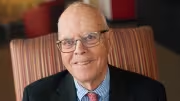
Michael D. Smith, dean of the Faculty of Arts and Sciences (FAS), was expected to tell colleagues at the fall’s first faculty meeting, on October 5, that the time has come to “change the channel” on campus conversations. “For the past two years,” he wrote in his annual report, “our decisions, though well grounded in intellectual priorities, often felt forced by the pressures of our financial circumstances.” Now it is suitable to “shift our attention more fully” to academic priorities, “charting actions in a manner that is informed by, but not dictated by, our financial resources.” (The report, made available to FAS members for the meeting, was set for public release on October 20, at www.fas.harvard.edu/home/content/2010-annual-report.)
Smith was expected to put the fiscal/academic year ended last June in context as the second stage in a three-part response to the global financial crisis. In this light, during fiscal 2009, “FAS arrested an aggressive growth trajectory established in times of plenty,” by cutting costs. The year just ended entailed the “harder work of making structural changes based on well-informed, long-term priorities.” The current year should mark the period of maximum belt-tightening, with another $35 million to be wrung out of annual operating expenses during the next 24 months (in anticipation of modest growth in endowment distributions soon; see “Endowment Improvements,” page 58).
The report does not quantify precisely how FAS dug itself out of an annual deficit projected at one time to be as large as $220 million. In the financial section, dean for administration and finance Leslie Kirwan lists contributing factors in the past year: savings on energy and discretionary expenses (travel, meals, etc.); the cumulative effects of early retirements and layoffs at the end of fiscal 2009, restraint in filling vacancies, and the year-long compensation freeze; and lower expenses than planned for science initiatives. Revenue gains helped, too: a change in state law authorized distributions from “underwater” endowment funds, worth millions of dollars to FAS; gifts exceeded expectations; sponsored-research grants and awards rose 11 percent, to $193.4 million. And FAS was able to buffer the anticipated 8 percent reduction in endowment distributions during the year by accessing what the financial footnotes called “the incremental distribution on all endowment funds,” thus holding the decrease in funds received to $30 million, just a 5 percent cut from fiscal 2009; the initial projection was a $50-million reduction.
The net effect was a $12-million unrestricted-funds surplus for FAS as a whole (down from $87.6 million in fiscal 2009), and a $3.6-million unrestricted surplus in FAS’s “core” operations (the faculty, College, and graduate school): well below the $58.6 million of fiscal 2009, but not deeply in the red, as once feared.
Kirwan pointed out challenges. Unrestricted spending for undergraduate financial aid rose $36.9 million in fiscal 2010, reflecting larger awards; less funding from the diminished endowment; and the depletion of balances the year before. The faculty and research-support ranks actually grew in fiscal 2010 (administrative and clerical personnel declined by 240 positions). Despite higher balances, investment income on short-term reserves declined $12.5 million (down more than 60 percent) as the central administration slashed the interest rate credited.
Smith’s upbeat tenor comes through particularly in his expressed enthusiasm for a forthcoming University capital campaign. FAS’s goals, he signaled, are due for presidential vetting by early spring. One ambition he highlights is programmatic: renewed focus on teaching and learning (as outlined by the Task Force on Teaching and Career Development three years ago; “Toward Top-Tier Teaching,” March-April 2007, page 63, on the faculty’s teaching “compact”). The second is a huge, deferred capital item: renovation of the undergraduate Houses--a task likely to consume at least a billion dollars over many years (see “Renewing the Houses,” July-August 2009, page 56). Kirwan outlined another need: “ensuring adequate resources to attract and retain outstanding faculty and graduate students.”
Of his own ideas, Smith wrote, “These…are not our only FAS aspirations.” But they ought to more than suffice to begin a conversation to “share our vision with the Harvard community”--part of an effort, after two years of looking inward, “that articulates to our alumni and the world the essential and unique nature of our institution and its mission.”