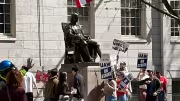
Occupy Harvard demonstrators protest potential library staff cuts

Demonstrators moved into Lamont Library Café Sunday evening.

Demonstrators in Lamont Café protested possible cuts to library staff.
The protesters vowed to remain in Lamont Café until Friday, February 17.
Protestors held a "Think Tank" Monday to discuss questions such as "What is a Library?" and "What does the library of the future look like?"
The occupation of Lamont Library Café stretched into Monday night.
Occupiers in Lamont Library, many of them doctoral candidates, were informed that violations of Library policy would result in suspension of their library privileges.
Lamont Occupiers were told Monday night that the use of sleeping mats or sleeping bags was being prohibited.

Library staff protests against the possibility of widespread layoffs as part of a reorganization of the Harvard Library took a new turn Sunday night, as Harvard student members of the Occupy movement took over Lamont Library Café, announcing their intention to stay until the 24-hour library’s regular Friday night closing at 10 p.m. this week. On Monday morning, a core group of seven or eight occupiers, mainly doctoral candidates, maintained a quiet (and studious) vigil, surrounded by posters with messages such as “YOU CAN’T EVICT AN IDEA,” “ANOTHER WORLD IS POSSIBLE” and “NO CUTS.” They distributed copies of a flyer explaining the purpose of their occupation with a schedule of events on the obverse side.

 A “general assembly,” at which library workers were expected, was scheduled for 6 p.m. Monday evening, as rumors circulated among staff that an early retirement incentive for library workers would be announced this week. But as one library staffer conferring with the protestors complained, the library workers who took an early retirement package during earlier cuts associated with the financial crisis are already under stress as the retiree share of healthcare costs rises.

The library occupiers are some of the same students who occupied Harvard Yard during the fall, joined now by Harvard students formerly involved in the Occupy Boston movement.

Update: Shortly after 11 a.m. Monday, the Lamont Occupiers were informed by a library administrator that their signs—which they regard as protected speech—violated what a library operations manager described as an "unwritten policy" against attaching signs to library buildings. The students argued that their signs were protected under the University's written policy protecting free speech, as can be seen in a video of the incident on the Occupy Harvard website. Members of the Harvard University Police department then removed the signs at the direction of the library manager over the protests of the Occupiers.

Monday evening, the protestors were given a written reminder of the library's rules and regulations, and informed that their library privileges would be suspended if they broke any of them. They were also told—this was not written down—that they could not use sleeping mats or sleeping bags.

 

Related topics

You might also like

Harvard Students, Alumni to Compete at the 2026 Olympics

Six Crimson athletes are headed to the XXV Winter Games in Milano Cortina 

FAS Announces New Endowment for Ph.D. Candidates

A $50 million gift from alumni donors aims to protect research opportunities amid political uncertainty

Teaching Through War With AI

Harvard Graduate School of Education students examine the use of AI in wartime Ukraine.

Most popular

Harvard Faculty Group Proposes Limits on A Grades

The grade inflation measure requires a full faculty vote, expected in the spring.

Why Men Are Falling Behind in Education, Employment, and Health

Can new approaches to education address a growing gender gap?

Ask a Harvard Professor with Rebecca Henderson

How to reform capitalism to confront climate change and extreme inequality, with economist and McArthur University Professor Rebecca Henderson

Explore More From Current Issue

Four men in a small boat struggle with rough water, one lying down and others watching.

The 1884 Cannibalism-at-Sea Case That Still Has Harvard Talking

The Queen v. Dudley and Stephens changed the course of legal history. Here’s why it’s been fodder for countless classroom debates.

A man skiing intensely in the snow, with two spectators in the background.

Introductions: Dan Cnossen

A conversation with the former Navy SEAL and gold-medal-winning Paralympic skier

An axolotl with a pale body and pink frilly gills, looking directly at the viewer.

Regenerative Biology’s Baby Steps

What axolotl salamanders could teach us about limb regrowth