A musty old book may have more than an unpleasant odor—it may have a disease. So collections conservator Ethel Hellman asks colleagues in the circulation and acquisition departments of Harvard libraries to keep their eyes (and noses) open for books with discoloration or unusual scents, the telltale signs of mold. But by the time a book begins to smell, the fungus is already damaging its host. “All we have now is: you see it or you smell it,” says Hellman. The problem is that there hasn’t been a way to find the dormant mold before it spreads.
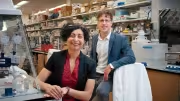
McKay professor of applied biology Ralph Mitchell is working on a test capable of detecting mold while its spores are still invisible—what he calls an early diagnosis. “These are infections,” he explains. “They will infect the other books and the next thing you know, you’ll have a bunch of moldy books.”
The attacker is airborne. Fungal spores multiply under warm or damp conditions. They feed on the cellulose in paper and beget new spores that can then disperse into the air and settle on other books: what begins as a localized problem can theoretically ruin an entire collection. Hellman sees mold as a major threat to the health of library holdings. Last year, the conservation lab (located beneath the steps of Widener) treated some 82,500 books. About one in a hundred suffered from mold infections, and once a book is moldy, it never completely recovers or goes back into circulation.
Books belong to the larger group of what Mitchell calls “cultural heritage materials.” This includes paintings, sculptures, historic buildings, and even tombstones—anything that is susceptible to microbial attack. He has been practicing preservation science for 15 years, and in that time he and his lab (which is atypical in looking at conservation from a biological, rather than chemical, standpoint) have worked to protect Neil Armstrong’s space suit from bacteria (see “Microbes Eat the Past,” January-February 2002, page 9) and prevent an underwater oil spill at the USS Arizona Memorial in Pearl Harbor.
Mitchell adapted his mold test from a European method that measures fungal levels in soil. The analysis, run mainly by postdoctoral fellow Nick Konkol, spots mold indirectly. Konkol first places the fungus Aspergillus niger (a common mold) and a drop of nutritious liquid on small circles of paper in petri dishes. He then removes a dish every 24 hours and adds a compound that breaks apart and fluoresces when it encounters the byproducts of mold growth. By measuring the amount of fluorescence on each sample, Konkol can track the fungal growth. Hellman initially provided test paper from the library, but after that ran out, Konkol bought his own supply, a yellowing study of Freud, for five dollars. (He made sure, he says, that the book was still in print.)
Although this research is still at an early stage, Konkol has already had some success: during a recent experiment, four paper discs appeared spotless 24 hours after being infected. When he tested them with a fluorometer, however, the machine detected the burgeoning mold. Konkol had proved the test effective, finding the fungus before he (or a librarian) could see or smell it. If Mitchell’s lab can develop the test further, Ethel Hellman says, “Every library out there, every colleague I have, would leap to have this tool.”