Headlines from Harvard history

A morgue for movies, and more from the Harvard Alumni Bulletin and Harvard Magazine

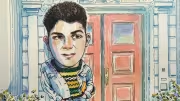
Illustration by Mark Steele

1917

The editors advise Harvard men who want to serve their country in case of war to contact Professor R. M. Johnston, who is “acting in correspondence with the Intercollegiate Intelligence Bureau.” College-educated men are particularly sought after, because “Intelligent, unhysterical effort in the handling of American resources, human and physical, in the months to come, may effect far-reaching results.” 

1927

The College Entrance Examination Board announces a new, standardized admissions exam called the Scholastic Aptitude Test. 

The Department of Fine Arts, backed by the Fogg Museum and the University Library, announces plans to establish a library of those “motion picture films” voted worthy, by a faculty committee, of preservation as works of art. 

1957

The “Harvard ‘Veritas’ Committee” circulates a letter urging fellow alumni to complain to the Board of Overseers about the appointment of J. Robert Oppenheimer ’26 as the biennial William James Lecturer. 

1962

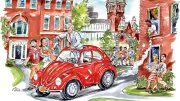
The Radcliffe Government Association’s rules committee recommends that any student past her freshman year be allowed to sign out of her dorm in the evening until any hour without advance permission. But, reports the Undergraduate columnist, a “determined number of ’Cliffies” insist that committee members mistakenly consider the average Radcliffe girl a stable and responsible adult capable of making reasoned decisions about “social problems.” Says one opponent, “People our age are notorious for being foolish.”

1972

The Committee on Housing and Undergraduate Life votes to condemn the term-paper industry after 40 to 60 student papers are stolen during intersession. Attorneys from Harvard and other Boston-area universities meet to consider possible court action to close the firms down.
Related topics

You might also like

250 Years Ago, Harvard Was Home to a Revolution

A look at the sights, sounds, and characters that put the University on the frontlines of history

The Woman Who Penned the Case for War

Mercy Otis Warren’s poetry and plays incited the Patriot movement.

How the American Revolution Freed a Future Abolitionist

Darby Vassall, an enslaved child freed after the Battle of Bunker Hill, dedicated his life to fighting for liberty.

Most popular

Martin Nowak Placed on Leave a Second Time

Further links to Jeffrey Epstein surface in newly released files.

At Harvard, Mitt Romney Warns Against ‘Authoritarian’ Presidential Power

The former senator touched on polarization, tech governance, and diplomacy during a conversation at the Institute of Politics.

Harvard Law Professor Explains the AI Battle Between Tech and Government

Jonathan Zittrain compares today’s conflicts to tensions surrounding the early internet.

Explore More From Current Issue

Bronze statues of three historical figures under a stylized tree in a softly lit space.

The Costly Choice Native Americans Faced

How the Revolution reshaped indigenous New England

Portrait of a man with white hair, wearing a black coat, arms crossed, thoughtful expression.

The Framer Who Refused to Sign the Constitution

Harvard’s Elbridge Gerry helped draft the U.S. Constitution, but worried it might create a new monarch.

A woman with long hair leans on a table, looking out a large window with rain-streaked glass.

A Harvard Economist Probes the Affordable Housing Crisis

From understanding gender pay gaps to the housing crisis, Rebecca Diamond’s research aims to improve lives.