
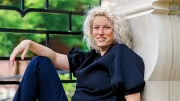
Jealous of elementary-school classmates who spoke foreign languages, Robinson professor of mathematics Lauren Williams found another way to communicate: code. Employing math tricks and patterns, she and her sister developed a system for conversing. Initially more interested in words than numbers, she’d attempted to write and illustrate her own fantasy novel. But after winning a fourth-grade math competition in her hometown of Palos Verdes, California, computation ascended. Summer programs for high-school students taught her that her interest wasn’t just a list of rules, but a creative field: “The idea that I could figure out something new that nobody knew before was very cool.” She entered the College interested in combinatorics, but no classes on the subject existed. Unfazed, Williams took algebra courses and worked on a combinatorics thesis with Richard Stanley at MIT. After graduating in 2000 and enrolling in a Ph.D. program there, she continued exploring new and under-studied fields: cluster algebras, tropical geometry. Her research continued as a professor at UC Berkeley, starting in 2009, where she made further breakthroughs with the positive Grassmanian, a shape whose points represent components of simpler geometric objects. This work has helped her model shallow-water waves and subatomic particle collisions—and become only the second woman to receive tenure in Harvard’s math department, in 2018. “As a researcher, what’s probably most rewarding to me is finding connections between fields that you don’t expect to be talking to each other.” Though most thinking takes place at her desk, some ideas emerge when playing with her children, six and nine. “Mama,” one said on her fifth birthday, “this is the greatest year of my life: I’m five, my name starts with an E, and I was born in May.” The patterns continue.
Math Professor Lauren Williams Explores New Ground
Williams feels at home researching underexplored subjects.

Lauren Williams
Photograph by Jim Harrison
You might also like

Meet the Harvard Alumni Association’s New President
David Battat promotes alumni engagement.

How CNN’s Abby Phillip Referees Political Debates
The Harvard graduate’s roundtable talk show touches on hot button issues from religion to sex.
Why Men Have Worn the Same Black Suits for 200 Years
Chloe Chapin trains her Broadway costume designer’s eye on the history of men’s fashion.
Most popular



Explore More From Current Issue

Why Harvard Medical School is training physicians to think more like coaches

The outgoing executive director and Harvard Business School graduate went from dancing The Nutcracker to growing a ballet company.

Can the College do more to prepare students for the real world?